Access to information and support under Article 19.16 of the Code of Administrative Offences of the Republic of Belarus
Documented restrictions, gaps in assistance and recommendations for organisations and institutions
LGBTQ+ House · Warsaw · September 2026
Contact:


About the study
Legal analysis of Article 19.16, published information on its enforcement and on access to assistance, and BLDPI data. The study distinguishes documented restrictions, risk assessments and data gaps.
Author and publisher: LGBTQ+ House. Published 22 September 2026. BLDPI series through 31 August 2026; document search completed 21 September 2026.
Contents
- Executive summary
- 1. Question, framework, method
- 1.1 Question and scope
- 1.2 Sources and assessment of reliability
- 1.3 Limitations
- 2. The provision, its place in the legal architecture and international standards
- 2.1 Text, sanctions, timing
- 2.2 The place of the provision among existing restrictions
- 2.3 What the provision does not define
- 2.4 International standards
- 2.5 Regional context
- 3. Baseline situation as at 19 June 2026
- 3.1 Organisations
- 3.2 Online resources
- 3.3 Printed publications
- 3.4 Discourse
- 3.5 Practice of persecution prior to the law
- 4. First months of the provision’s operation: 19 June – 31 August 2026
- 4.1 Law enforcement
- 4.2 Information support
- 4.3 Related events during the period
- 4.4 Response of international mechanisms
- 5. Access to information
- 6. Access to support
- 6.1 Legal assistance
- 6.2 Psychological assistance
- 6.3 Medical care for transgender people
- 6.4 Assistance with departure and international protection
- 6.5 Support in detention
- 6.6 Different groups: what is known and what is not
- 7. What remains unknown
- 8. Recommendations
- 8.1 To organisations providing assistance
- 8.2 To Polish institutions
- 8.3 To the institutions of the European Union
- 8.4 To international UN mechanisms
- 8.5 To platforms
- 8.6 To donors and researchers
- Annex A. Chronology
- Annex B. Search protocol and scope of review
- How to cite
- Notes
About this document. LGBTQ+ House is the author and publisher of the study and the developer of the Belarus LGBTQ+ Discourse Pressure Index (BLDPI), the data from which are used in sections 3 and 4; the index is presented in the published version 2026.08 without recalculation.[1] The search protocol and scope of verification are described in Annex B. The BLDPI series covers the period up to 31 August 2026; the search for documents and publications was completed on 21 September 2026, and individual references and legal sources were additionally checked on 22 September. Dated information on enforcement is analysed within this period; reports of cases without disclosed dates are presented separately and are not included in periodic counts. One hundred days of the provision being in force falls on 27 September 2026, after the publication of the study.
Executive summary
Article 19.16 of the Code of Administrative Offences of the Republic of Belarus (hereinafter the Code of Administrative Offences) has been in force since 19 June 2026. It provides for punishment for disseminating information which, in the assessment of the law-enforcement authority, is aimed at forming among citizens perceptions of the “attractiveness” of homosexual relations, gender transition or childlessness. The research question is: in the first months of the provision’s operation, what has happened to LGBTQ+ people’s access in Belarus to information and assistance, what of this is documented, what constitutes a substantiated risk, and what remains unknown.
- By the time the provision was introduced, access to information about LGBTQ+ people had already been substantially restricted. By 19 June 2026, registered LGBTQ+ organisations in Belarus had been liquidated; the resources of six LGBTQ+ initiatives and activists, a dating chat and the websites of two human rights organisations were included in the National List of Extremist Materials by court decisions; the list of banned printed publications numbered 258 titles, including LGBTQ+ literature. Article 19.16 introduces an independent basis for administrative liability for disseminating information with the purpose specified in the Article; unlike the regime for extremist materials, its application is not conditional on the prior inclusion of specific material in any list.
- The provision is being applied; the scale of its application cannot be measured. TG House reported the first documented prosecution under Article 19.16 on 15 August 2026; on 8 September it reported three cases it had confirmed, without disclosing the nature of the measures or the dates, and other cases not yet documented. Between May and August, the organisation received 24 requests from LGBTQ+ people reporting persecution, threats or a risk of repression; by 8 September it had helped ten of them leave the country; six of the 24 had an official document concerning the persecution. In the open sources reviewed, no court decisions or publicly available official statistics under Article 19.16 were found.
- The peaks of discursive pressure coincided with the signing of the law and the provision’s entry into force; the parliamentary readings did not produce peaks; in April the peak was driven by channels of state bodies and the media. In April 2026, the month in which the law was adopted, the weighted BLDPI index increased by 283.8 %; the share of state bodies in it increased by 20.5 percentage points, the media by 16.0, while the share of propaganda channels fell by 40.3. In May the index fell to its lowest level since monitoring began (822); in June, the month of entry into force, it produced a second, three-times smaller spike, mainly due to the media; in August it reached a new low (624). This is consistent with the hypothesis of information support for legislative changes; monthly aggregates do not make it possible to establish the causes of the dynamics or their connection with law enforcement. The index measures the intensity of discourse within the observation frame, not people’s safety, and does not make it possible to judge changes in the number of requests for help.
- Registered LGBTQ+ organisations inside the country have been liquidated, information about other forms of specialised assistance is limited, and seeking help from outside entails legal risk. A legal analysis of the adopted provision for citizens was published by the Belarusian Helsinki Committee (BHC), which in April 2026 was included in the list of organisations, formations and sole proprietors involved in extremist activity, and by Prismatica, whose Instagram is included in the National List of Extremist Materials. Subscribing to resources from this list is prosecuted under Article 19.11 of the Code of Administrative Offences. The medical procedure for gender transition remains in place, but, according to TG House, at the commission meeting on 10 June 2026, 19 of 29 applicants for legal gender recognition were refused (at the two previous meetings the refusal rates were 80 and 71 %), and public information about the procedure, in the assessment of the Belarusian Helsinki Committee, may be deemed “propaganda of sex change”.
- At the same time, the conditions for obtaining protection outside Belarus are changing. According to Eurostat, the share of refusals to citizens of Belarus at first instance in Poland rose from 2.6 % in the first quarter of 2026 to 24.2 % in the second (n = 310); according to UdSC cumulative reports, in June and July 2026 refusals accounted for 67.5 % and 85.4 % of substantive decisions, while the recognition rate for 2026 fell from 95 % on 1 June to 79 % on 1 August. A publication, citing a lawyer, reported that the country information used in one case assessed repression as having decreased; the overall reason for the change in the statistics has not been established. Poland does not publish data by grounds of sexual orientation and gender identity, so it is not possible to establish from the statistics whether Article 19.16 is taken into account in specific cases.
Three main recommendations. To assistance organisations: maintain a coordinated register of cases of application of Article 19.16 and structure counselling as a channel that reduces the risk of identifying the user. To Poland’s Office for Foreigners (UdSC): update the country assessment taking into account Article 19.16, the report of the UN Special Rapporteur A/HRC/62/52, the report of the European Union Agency for Asylum (EUAA) of May 2026 and the EUAA case-law review of September 2026; publish statistics on decisions by grounds of persecution in aggregated form. To the UN Special Procedures: send the Government of Belarus a communication on the enforcement of the adopted provision with the participation of the Special Rapporteur in the field of cultural rights.
The primary duty-bearer remains the Republic of Belarus: the repeal of discriminatory restrictions, the cessation of persecution for lawful expression and the securing of access to information and assistance are required of it by UN mandates (December 2025, April 2026), Belarusian human rights organisations (July 2025) and states within the Universal Periodic Review (UPR) (November 2025). In the addendum of 8 January 2026, Belarus marked all eight recommendations on sexual orientation and gender identity as not supported, classifying them as “politicised recommendations containing one-sided value judgements”.[2] Therefore the study’s practical recommendations are addressed primarily to institutions of third countries, international mechanisms and organisations.
1. Question, framework, method
1.1 Question and scope
How Article 19.16 of the Code of Administrative Offences changed LGBTQ+ people’s access in Belarus to information on sexual orientation, gender identity, health and rights, and to legal, psychological and medical assistance and assistance with departure; which changes are documented, which are a substantiated risk, which remain unknown; what organisations and institutions can do. The study is based on an analysis of the draft provision in UN special procedures communication OL BLR 13/2025[3] and on case law concerning similar restrictions in other countries (section 2.4), does not recalculate the BLDPI and does not collect new interviews or surveys inside Belarus for reasons of respondents’ safety. Letter OL BLR 13/2025 concerned the draft law; assessments of the adopted provision are contained in the statement by UN experts of 15 April 2026[4] and in report A/HRC/62/52.[5]
1.2 Sources and assessment of reliability
The study is based on published materials: legal acts of Belarus and Poland; UN documents (four reports to the Human Rights Council, a report to the General Assembly, the outcomes of the Universal Periodic Review (hereinafter UPR), concluding observations of three treaty bodies); Views of the Human Rights Committee, judgments of the ECtHR and the Court of Justice of the EU (CJEU); publications of Belarusian human rights organisations and international organisations; a peer-reviewed academic publication on the empirical consequences of the Russian “propaganda” law (section 2.5); official statistics from Eurostat and the Polish Office for Foreigners (Urząd do Spraw Cudzoziemców, hereinafter UdSC); media publications as carriers of primary data; the BLDPI dataset. To detail the April peak, message- and channel-level BLDPI data not included in the public repository were additionally used (section 4.2). Quotations from English- and Polish-language sources are given in the author’s translation; the names of court cases are given in Russian with the original name at first mention. The tables indicate the types of sources used (Table 1); they are not a reliability ranking. The status of a specific assertion is determined by its attribution and the available corroboration. The text of Law No. 138-Z was used as officially published on the National Legal Internet Portal (18.04.2026, 5-2/3224).
Table 1. Types of sources used in the study
| Code | Meaning | Example |
|---|---|---|
| D1 | Primary document: text of a provision, UN document, official statistics, court decision | Law No. 138-Z; A/HRC/62/52; Eurostat |
| D2 | Case reported by the documenting organisation, with attribution retained; the verification method is indicated where disclosed | cases documented by TG House |
| D3 | Aggregated data from an organisation or index; the methodology is indicated where published | BLDPI series; TG House information on commission meetings |
| D4 | Small sample or single testimony; illustration, not statistics | TG House surveys, n = 20–21 |
| R | Risk assessment by a competent source in the absence of a documented case | occupational risk groups |
| N | Data are absent or unavailable | number of administrative offence records under Article 19.16 |
Source: compiled by the author.
One-source rule. Most cases from 2025–2026 are documented by TG House. ILGA-Europe, Prismatica, EUAA, the UN Special Rapporteur (A/HRC/62/52, footnote 61) and the media reproduce its data with attribution; in this study, this is treated as one source. The origin of the data is checked for each assertion. The UN Group of Independent Experts’ own interviews (181 interviews in 2025 across all topics of the mandate)[6] serve as a separate source of information where the report relies on them, rather than on a retelling of monitoring. Eurostat data for Poland are based on national reporting and are not considered independent confirmation of UdSC statistics; a UN or EUAA document reproducing an organisation’s monitoring does not constitute a new independent observation. Indicators from different monitoring exercises are not added together (Table 6). The assertion that “the actual numbers are higher” applies only to counts of cases and requests limited by documentation capacities; it does not apply to percentages or to the index.
1.3 Limitations
Documentation within Belarus is substantially restricted by repression, the liquidation of organisations and risks for victims and for those who gather information; documenting organisations themselves state that a significant proportion of violations remains undocumented.[7] TG House surveys are used as illustrative information; known sample sizes are given when describing the relevant results. The material on Russia (section 2.5) describes the consequences of a different law in a different country. No publicly available official statistics on enforcement were found, so section 4 relies on data from one organisation, with this limitation indicated.
2. The provision, its place in the legal architecture and international standards
2.1 Text, sanctions, timing
Article 19.16 “Propaganda of homosexual relations, sex change, childlessness, paedophilia” was introduced by para. 85 of Article 1 of Law of the Republic of Belarus of 15 April 2026 No. 138-Z “On Amending Codes on Matters of Administrative Liability”.[8] The draft was introduced in the House of Representatives by the Council of Ministers on 9 July 2025 (incoming No. 3323),[9] adopted at first reading in October 2025 and at second reading on 13 March 2026, approved by the Council of the Republic on 2 April, signed on 15 April, and officially published on the National Legal Internet Portal on 18 April 2026 (reg. No. 5-2/3224). Under Article 4 of the law, para. 85 entered into force two months after publication, on 19 June 2026.
Part 1: “Dissemination in any form of information for the purpose of shaping citizens’ perceptions of the attractiveness of homosexual relations, sex change, childlessness, or the recognition of paedophilia as permissible”. Part 2: the same act, “which resulted in a minor becoming acquainted with such information”. The base value (BV) from 1 January 2026 is 45 roubles[10]; the conversion into euros was made at the official exchange rate of the National Bank on 19 September 2026 (3.4736 roubles per euro) and rounded to tens.[11]
Table 2. Sanctions under Article 19.16 of the Code of Administrative Offences
| Subject | Part 1 | Part 2 |
|---|---|---|
| Natural person | fine of up to 20 BV: up to 900 roubles (about €260) | fine of 20–30 BV: 900–1 350 roubles (about €260–390), or community service, or administrative arrest for up to 15 days |
| Individual entrepreneur | up to 100 BV: up to 4 500 roubles (about €1 300) | 100–150 BV: 4 500–6 750 roubles (about €1 300–1 940) |
| Legal entity | 100–150 BV: 4 500–6 750 roubles (about €1 300–1 940) | 150–200 BV: 6 750–9 000 roubles (about €1 940–2 590) |
Source: Law No. 138-Z; Council of Ministers Resolution No. 651; NBRB, exchange rate as at 19.09.2026. Author’s calculation.
The same law introduced Article 24.62, “Unlawful Representation of the Republic of Belarus at International Events”, and expanded liability for the receipt and misuse of foreign aid (Article 24.53). Lawtrend characterises the package as an expansion of administrative regulation in three areas of civil-society activity: informational, financial and international.[12] UN experts noted that Article 24.62 could be applied to those who interact with the UN.[13]
2.2 The place of the provision among existing restrictions
As at 19 June 2026, five mechanisms restricting information about LGBTQ+ people were in force; they differ by ground and type of liability (Table 3).[14][15] Article 19.16 establishes a separate ground for administrative liability for disseminating information with the purpose specified in the Article. Unlike liability for disseminating materials from the National List of Extremist Materials, its application is not conditional on the prior inclusion of the specific material in such a list; unlike Article 37-1 of the Law “On the Rights of the Child”, it is not limited to information addressed to children.
Table 3. Mechanisms restricting information about LGBTQ+ people in Belarus as at 19 June 2026
| Mechanism | In force from | What is prohibited | Who is responsible | Liability | Condition for application |
|---|---|---|---|---|---|
| Resolution of the Ministry of Culture No. 24: supplements the Instruction on erotic products with a definition of “non-traditional sexual relations and/or sexual behaviour” (including “homosexuality, lesbian love”, “transsexualism”) and classifies them as “sexual perversions” | 12.04.2024 | display, storage for the purpose of distribution, and distribution of materials recognised as pornographic | author, distributor | administrative (Article 19.7 of the Code of Administrative Offences, 2–30 base values (BV)) or criminal (Article 343 of the Criminal Code, up to 4 years) | classification of specific material as pornography |
| National List of Extremist Materials | LGBTQ+ resources since 28.03.2024 | dissemination of materials from the list; in practice, subscribing and storage are prosecuted | distributor, user | administrative (Article 19.11 of the Code of Administrative Offences: fine, arrest for up to 15 days, confiscation) | court decision to include a specific resource |
| List of organisations, formations and sole proprietors involved in extremist activity (maintained by the Ministry of Internal Affairs (MVD) pursuant to Council of Ministers Resolution No. 575) | human rights and LGBTQ+-friendly entities, 2023–2026 | participation, assistance, financing | participants, persons providing assistance | criminal (Articles 361-1, 361-4 of the Criminal Code) | decision of the Ministry of Internal Affairs (MVD), the KGB or a court concerning a specific structure |
| List of printed publications “causing harm to national interests” | 21.11.2024 | distribution of publications from the list | seller, publisher, library | administrative | commission decision on a specific publication |
| Law “On the Rights of the Child”, Article 37-1, second part | 17.01.2026 | information “discrediting the institution of the family and marriage and family relations, aimed at propaganda of homosexual relations, sex change, paedophilia, childlessness”, as harmful to the health and development of children | disseminator of information for children | through related provisions | addressee — a minor |
| Article 19.16 of the Code of Administrative Offences | 19.06.2026 | dissemination of information recognised as aimed at forming “notions of attractiveness” | the disseminator, including private individuals | administrative: fine, community service, arrest; legal entities up to 200 BV | qualification of the purpose of dissemination by the law-enforcement authority; no prior act concerning the material is required |
Sources: Resolution of the Ministry of Culture No. 24; official lists of the Ministry of Information; the Ministry of Internal Affairs (MVD) list and Council of Ministers Resolution No. 575; A/HRC/59/59, paras. 62–63, 80; Law No. 86-Z; Law No. 138-Z. The dates of Resolution No. 24 are given according to the act (adopted on 19.03.2024, published on 11.04.2024, in force from 12.04.2024); in A/HRC/62/52 (para. 53) the amendment is dated April 2025.
2.3 What the provision does not define
Belarusian legislation contains no definitions of “homosexual relations”, “childlessness” or “attractiveness”; “sex change” is defined only as a medical procedure.[16] The term “paedophilia” is not defined in legislation: criminal law punishes specific acts of a sexual nature against persons under the age of sixteen (Article 168 of the Criminal Code and related offences), while the medical classification describes a disorder of sexual preference (F65.4 under ICD-10).[17] Under the Law on Information, “dissemination of information” covers oral, written, audio and visual forms and “making information available to an indefinite circle of persons”; the provision does not specify whether this extends to closed groups.
The main uncertainty is created by the wording “with the aim of forming citizens’ perceptions of attractiveness”. The Belarusian Helsinki Committee (BHC) describes two scenarios: a broad one, in which the mere public availability of information about sexual orientation is regarded as influencing “perceptions”, and a narrow one, requiring a direct or indirect appeal to perceive the phenomenon as the norm.[18] Russian Article 6.21 of the Code of Administrative Offences of the Russian Federation, which served as the model, contains a more detailed definition; the Belarusian provision is shorter. Lawtrend: “even neutral information, research or educational programmes may be interpreted as ‘forming a positive attitude’”.[19] UN experts: the wording “may create conditions for arbitrary application”.[20] The medical procedure for gender transition remains legal, but, according to the Helsinki Committee, “discussion of how it works, public sharing of experience and advice on how to undergo it may be regarded as ‘propaganda’”. Part 1 applies regardless of the age of the addressee; Part 2 merely increases the sanction. No published decisions for the period up to 31 August 2026 were found in the sources reviewed.
2.4 International standards
The UN Human Rights Committee has twice recognised Russian regional laws on “propaganda” (of Ryazan and Arkhangelsk Regions) as a violation of Articles 19 and 26 of the International Covenant on Civil and Political Rights (ICCPR): Fedotova v. Russian Federation (2012)[21] and Nepomnyashchiy v. Russian Federation (2018).[22] The legal approaches set out in these Views are important for assessing the Belarusian provision. At the same time, the possibility of submitting new individual communications against Belarus to the Committee is no longer open after the denunciation of the First Optional Protocol to the Covenant took effect on 8 February 2023; the only treaty body competent to consider individual complaints remains the Committee on the Elimination of Discrimination against Women.[23] Obligations under the Covenant itself remain in force. In its 2018 concluding observations, the Committee recommended that Belarus include sexual orientation and gender identity in anti-discrimination legislation and noted violations of the privacy of transgender people through the sex digit in the passport identification number and category 19a in military IDs.[24]
In 2020, the Committee on the Rights of the Child recommended that Belarus adopt anti-discrimination legislation covering sexual orientation and gender identity, protect LGBTQ+ children from bullying, and provide sexual education with attention “to the issues of sexual orientation and gender identity”[25]; in General Comment No. 20, the Committee requires the repeal of laws that discriminate on these grounds and the removal of barriers to LGBTQ+ adolescents’ access to information and services.[26] In February 2025, the Committee on the Elimination of Discrimination against Women recommended that Belarus ensure women’s autonomy in deciding whether to have children and eliminate practices that punish reproductive choices[27]; fourteen months later, “propaganda of childlessness” became an administrative offence.
The European Court of Human Rights (ECtHR) in Bayev and Others v. Russia (2017) found Russian “propaganda” laws to violate Articles 10 and 14 of the European Convention on Human Rights.[28] The Grand Chamber of the ECtHR in Macatė v. Lithuania (2023) unanimously held that labelling a children’s book containing fairy tales about same-sex families as harmful to children did not pursue a legitimate aim[29]; this is the closest precedent to the Belarusian list of prohibited publications. Belarus is not a party to the Convention; the Court’s case-law is of comparative significance for it. On 21 April 2026, the Court of Justice of the EU (CJEU), in Commission v Hungary (C‑769/22), for the first time in proceedings against a Member State found a standalone breach of Article 2 of the Treaty on European Union by a law restricting access to LGBTQ+ content under the pretext of protecting children.[30] EU law does not apply to Belarus; the significance of the judgment is that the EU has a position from its highest judicial authority on laws of this type, on which its foreign-policy statements may rely. For international protection procedures, the Court of Justice of the EU (CJEU) has held that an applicant cannot be required to conceal their sexual orientation (Joined Cases X, Y and Z v Minister for Immigration and Asylum of the Netherlands, the applicants are designated by letters, C‑199/12–C‑201/12, 2013)[31] and has limited the methods by which it may be assessed (Cases A, B and C, C‑148/13–C‑150/13, 2014)[32]; the Guidelines of the Office of the United Nations High Commissioner for Refugees (UNHCR) No. 9 set the standard for assessing such claims.[33] The EUAA, in its review of case-law for 2025–2026, summarises: criminalisation or legal restrictions on expression may amount to persecution; late disclosure of orientation is not in itself a sufficient ground for finding an application not credible; and there are no centralised EU data on applications on the grounds of sexual orientation and gender identity.[34]
Table 4. Elements of Article 19.16 and applicable international standards
| Element of the provision | Right affected | Applicable standard | Issue |
|---|---|---|---|
| “Dissemination of information in any form” without defining the subject matter (“homosexual relations”, “childlessness”) | freedom of expression; legality of the restriction | Article 19 (3) ICCPR: the restriction must be provided by law, formulated with sufficient precision | the vagueness of the terms makes it difficult to foresee which message the law-enforcement authority will consider a violation (requirement of legal certainty: CCPR/C/GC/34, para. 25) |
| The purposive element “for the purposes of shaping perceptions of attractiveness” | freedom of expression; prohibition of discrimination | Articles 19 and 26 of the ICCPR; Fedotova and Nepomnyashchiy v. Russian Federation: the prohibition of “propaganda” on grounds of orientation is itself discrimination | the vagueness of the purposive element creates a risk that neutral or positive information about LGBTQ+ people will be classified as an administrative offence; no published practice enabling the boundaries of interpretation to be established has been found |
| Part 1: liability regardless of the age of the addressee; Part 2: increased sanction where a minor is exposed to the material | freedom of expression; children’s right to information | Articles 13 and 17 of the Convention on the Rights of the Child (CRC); CRC/C/GC/20, paras. 33–34, 60; Macatė v. Lithuania | the stated aim of protecting children does not explain part 1; for children and adolescents, the standards require access to age-appropriate information, not a ban |
| Fine, community service, arrest for up to 15 days; legal entities: up to 200 base values (BV) | proportionality of the restriction | Article 19 (3) ICCPR: necessity and proportionality; Bayev and Others v. Russia | arrest for up to 15 days for a statement about a lawful phenomenon requires an assessment of necessity and proportionality (CCPR/C/GC/34, paras. 33–35); high fines for organisations create a risk of refraining from lawful information and awareness-raising activities |
| “Sex change” as a subject of prohibited information | right to health; access to medical information | Article 12 of the International Covenant on Economic, Social and Cultural Rights (ICESCR); CCPR/C/BLR/CO/5, paras. 19–20; A/HRC/62/52, para. 55 | a lawful medical procedure remains available, but information about it and the sharing of experience risk being classified as “propaganda” |
| “Childlessness” as a subject of prohibited information | reproductive autonomy; equality of women | Article 16 of the Convention on the Elimination of All Forms of Discrimination against Women (CEDAW); CEDAW/C/BLR/CO/9, para. 30 | after the Committee’s recommendation, liability was introduced for disseminating information aimed at forming perceptions of the attractiveness of childlessness; this creates a risk of restricting discussion of reproductive choice |
Source: compiled by the author based on the text of Law No. 138-Z and the documents listed in the “Applicable standard” column; the requirements of certainty, necessity and proportionality — CCPR/C/GC/34.[35]
The public justification of the provisions on “propaganda” in Belarus, as in Russia, appeals to the protection of children[36]; Part 2 of Article 19.16 singles out making information available to minors. This argument does not answer the problems set out above for three reasons: Part 1 applies regardless of the recipient’s age, so the protection of children in itself does not explain the restriction of information disseminated among adults; for children themselves, international standards require access to age-appropriate information on sexual orientation and gender identity, not its prohibition[37]; and in the cases Bayev, Macatė and C‑769/22, the courts that examined the same argument in relation to Russian, Lithuanian and Hungarian laws found that restricting information about LGBTQ+ people does not serve the protection of children and entrenches prejudice;[38][39][40] for assessing the Belarusian provision, their conclusions are of comparative significance.
In the Universal Periodic Review (UPR) in November 2025, Belarus received eight recommendations on sexual orientation and gender identity (146.130, 147.7, 147.51, 147.63–147.67), including recommendations by Portugal (147.63) and Denmark (147.67) to abandon the draft Article 19.16. In January 2026, Belarus rejected all eight.[41]
2.5 Regional context
The wording of Article 19.16 borrows the model of Russian Article 6.21 of the Code of Administrative Offences of the Russian Federation (2013; since 2022 without an age threshold, and since December 2024 also “refusal to have children”[42]); Human Rights Watch characterises the Belarusian law as a borrowing of the Russian model.[43] Provisions on “propaganda” are also in force in Hungary (2021), Kyrgyzstan (2023), Bulgaria (2024, in education), Georgia (2024) and Kazakhstan (December 2025); for EU institutions, this means that the Belarusian law belongs to a type on which the EU has had a judicial position since April 2026.[44] Empirical data on the harm caused by such provisions were obtained in Moscow: in a cross-sectional study of men who have sex with men (MSM; data collection October 2010 – April 2013), among those reporting experienced stigma, being surveyed after the adoption of the St Petersburg law of 7 March 2012 banning “propaganda of homosexuality” among minors, which preceded the 2013 federal law, was associated with higher odds of pronounced depressive symptoms on the CES-D scale (adjusted odds ratio 2.24; 95 % CI 1.49–3.39); the design does not allow the causal effect of the law to be established, and these data do not measure the consequences of the Belarusian provision.[45]
3. Baseline situation as at 19 June 2026
The section describes the restrictions that had developed by 19 June 2026; later updates to the official lists are indicated separately.
3.1 Organisations
According to Lawtrend’s monitoring, from 2021 to the end of April 2026 at least 1 240 non-profit organisations were forcibly liquidated and at least 782 liquidated themselves; the sector’s aggregate losses since 2020 amount to at least 2 022 organisations.[46] According to TG House’s assessment in its report for the 2025 Universal Periodic Review (UPR), previously operating LGBTQ+ organisations have been liquidated: “All previously existing organisations have been liquidated. As a result, LGBTQ+ people have been deprived of access to legal, social and psychological support within the framework of the law.”[47] The list of organisations, formations and sole proprietors involved in extremist activity, which the Ministry of Internal Affairs (MVD) maintains on the basis of decisions by the Ministry of Internal Affairs (MVD), the KGB and courts[48], as of 20 August 2026 contained 377 continuously numbered entries, of which two (Nos. 373 and 375) were decisions amending previously included entries, that is, 375 separate entities. Organisations’ counts differ by the method used to set the cut-off: Lawtrend gives 365 entities as of the end of April 2026 — that is the number of entries with decisions that had entered into force by 30 April (entry No. 365 was added to the list on 4 May); Viasna gives 373 in June — that is the number of entries included in the list by 30 June.[49][50][51] For LGBTQ+ people’s access to information and assistance, the listed structures of three types are significant: human rights organisations that provided legal explanations and monitoring of restrictions — the Viasna Human Rights Centre (Ministry of Internal Affairs (MVD) decision of 24.08.2023), Human Constanta (KGB decision of 11.03.2026, included on 18.03.2026) and the Belarusian Helsinki Committee (BHC) (KGB decision of 31.03.2026, included on 06.04.2026); LGBTQ+-friendly initiatives, described as such in the TG House review — “Spadcyna Belarusi” (KGB decision of 11.03.2026, included on 18.03.2026) and “ІншыЯ” / “The Others” (KGB decision of 09.04.2026, included on 24.04.2026); and an association of lawyers — the “Belarusian Association of Human Rights Lawyers” initiative (included on 22.08.2025).[52][53] Participation in an extremist formation is punishable under Article 361-1 of the Criminal Code, and assistance under Article 361-4.
3.2 Online resources
Table 5. Resources of LGBTQ+ initiatives and organisations covering the rights of LGBTQ+ people included in the National List of Extremist Materials, March 2024 – April 2026 (dates of entry into force of court decisions according to the list)
| Date | Resource | Source |
|---|---|---|
| 28.03.2024 | TG House: website tghouse.org, Facebook, Instagram, Telegram channel and chat (Central District Court of Minsk) | Ministry of Information list; TG House, report to the Universal Periodic Review (UPR), para. 25; A/HRC/59/59, para. 62 |
| 07.06.2024 | The belhelcom.org website and the Facebook page of the Belarusian Helsinki Committee (BHC) (Zheleznodorozhny District Court of Gomel; a joint decision with resources of other organisations) | Ministry of Information list |
| 11.09.2025 | DazHip media: Instagram das.hip.media (Pukhovichi District Court); the Telegram channel and Facebook page named in the TG House monitoring were not identified in the list under this name | Ministry of Information list; TG House, 2025 monitoring |
| 25.12.2025 | Telegram chat «Знакомства • ЛГБТ | ЧАТ» (Dating • LGBT | CHAT) (Leninsky District Court of Mogilev) | Ministry of Information list; TG House, 2025 monitoring |
| 24.02.2026 | Human Constanta website and social media (Chashniki District Court) | Ministry of Information list; Lawtrend, April 2026 |
| 05.03.2026 | Instagram takija.samyja (Sovetsky District Court of Minsk) | Ministry of Information list; Prismatica |
| 12.03.2026 | Instagram prismatica.belarus (Sovetsky District Court of Minsk) | Ministry of Information list; TG House, review of the first half of 2026; Prismatica |
| 23.03.2026 | Instagram nasta.bazar of activist Nasta Bazar (Court of Baranovichi District and the city of Baranovichi) | Ministry of Information list; Prismatica |
| 13.04.2026 | Instagram jane.horney of activist Jane (Dobrush District Court) | Ministry of Information list; TG House, review of the first half of 2026 |
Source: National List of Extremist Materials of the Ministry of Information (version with decisions through 18.09.2026): name of the court and date of entry into force of the decision; identification of resources — according to publications by TG House and Prismatica. The Belarusian Helsinki Committee (BHC) and Human Constanta are general human rights organisations that cover, among other things, the rights of LGBTQ+ people.[54]
The list grew from 6 982 entries in March 2025[55] to 8 172 in December 2025; a quarter of the entries were added in 2025.[56] Liability for disseminating materials from the list is provided for by Article 19.11 of the Code of Administrative Offences; in practice, subscriptions and storage are prosecuted: TG House documents three cases of administrative prosecution for subscriptions in the first half of 2026.[57] The inclusion of a dating chat in the list shows that the restrictions also affect everyday communication within the community.
3.3 Printed publications
The list of printed publications “whose dissemination is capable of causing harm to national interests” has been maintained by the Ministry of Information since 21 November 2024; the initial list of 35 publications included “manga, LGBTQ+ literature, erotic fiction”.[58] By 15 October 2025, there were 173 publications on the list[59], following the addition on 26 May 2026 — 258.[60][61] This is the total number of publications on the list, not the number of LGBTQ+ books: the inclusion criteria are broader. The UN Special Rapporteur, as of 15 March 2026, refers to 330 banned books[62]; the scope of this count is not disclosed in the report, and the discrepancy remains unresolved; below, the figure 258 from the current version of the official Ministry of Information list is used. The Ministry’s criteria are: publications “promoting non-traditional sexual relations … popularising subcultures that are non-traditional for Belarusian society, as well as publications on sex education for children”. Decisions are taken by the Republican Commission for the Evaluation of Symbols, Attributes and Information Products; 11 of its 22 members represent law-enforcement/security agencies.[63] Human Constanta, analysing the official list, noted at the end of the second quarter of 2026: “the mere presence of LGBTQ+ characters in the text, regardless of genre and artistic context, appears to remain sufficient grounds for including a book in the list”.[64] The Minister of Information called the list “not censorship in the classical sense, but an analogue of sanitary control and vaccination at the same time”.[65]
3.4 Discourse
BLDPI covers 520 public Telegram channels with editorial teams inside Belarus, distributed across nine fixed categories of sources; this is an observation frame, not a representative sample of the population or the media. The unit of observation is a public channel message, including forwards: the index measures the fact that a signal was disseminated by a given source, not authorship. Relevant messages are selected automatically, after which each of them is checked manually; each is assigned a pressure intensity code D (0 — irrelevant; 1 — instrumentalisation, stigma; 2 — hate speech, dehumanisation, threats; 2.5 — institutional pressure by the authorities). A message’s contribution to PI = D · W · L, where W is the institutional weight of the source category from 1.0 (tabloid-style Telegram channels) to 3.0 (judicial/legal sphere), L = log10(1 + number of subscribers at the time of scanning); monthly PI is the sum across messages, rounded by category. The Positive Deviation Index (PDI) is calculated in the same way for messages defending rights; such messages are not included in PI. A category’s share in PI is a share of the weighted indicator, not a share of publications, audience or public opinion; the weights and logarithmic normalisation make the scale sensitive to large channels; a zero PDI means the absence of signals detected by the method. Changes in the composition of the frame are recorded and noted in monthly summaries. How to read the index. A PI point is a notional unit: a message with intensity code 2 from a national media outlet (weight 2.2) with 100 000 subscribers gives 2 · 2.2 · 5.0 = 22 points, while the same message from a tabloid-style channel (weight 1.0) with 10 000 subscribers gives 8 points; monthly PI is the sum of the contributions of all included messages (in April 2026, 5 020 points across 426 messages). PDI is calculated in the same way for messages defending the rights of LGBTQ+ people; zero in a number of months means that the method did not detect a single such message in the 520 channels. From September 2025 to March 2026, PI remained in the range of 1 135–1 902 points per month; in most months, the largest share of PI was accounted for by propaganda channels (from 49 to 74 %), while the contribution of the media category varied noticeably (from 17 to 45 %).[66] The indicator uses the weights and coding scale specified by the author of the index; its points are not the number of affected persons or unique readers. Manual verification covers the messages included in the calculation and does not assess the completeness of the automatic detection of relevant messages; the “Media” category combines republican and regional media without a breakdown by form of ownership. Prismatica describes the main themes of this discourse: the LGBTQ+ agenda as a Western threat, links to foreign funding, and the merging of political and LGBTQ+ stigma.[67]
3.5 Practice of persecution prior to the law
UN Special Rapporteur: from August to October 2024, 32 people identifying as LGBTQ+ were detained, “in what appeared to be an unprecedented act of repression against this community”; criminal cases under Article 343 of the Criminal Code are initiated “merely for posting photos of themselves online, fully clothed and without sexual acts”.[68] For 2020 – early 2025, TG House documents 46 detentions, 40 cases of forced emigration and three criminal cases under Article 343 for photographs[69]; for 2025 — a raid by a special-purpose police unit (OMON) on a queer party at the Minsk club “Reaktor” on 19 September (10–15 detainees, reports for “minor hooliganism”), the detention of psychologist Marina A. by KGB officers on 29 April with the threat of a criminal case, fake dates via a dating app, and pressure on the parents of those who had left.[70] The UN Group of Independent Experts (GIE), on the basis of its own interviews, confirms that LGBTQ+ prisoners are placed in the category of “low social status” with harsher conditions of detention.[71]
4. First months of the provision’s operation: 19 June – 31 August 2026
4.1 Law enforcement
The first public report of the application of the provision is dated 15 August 2026: TG House director Alisa Sarmant told Euroradio that the organisation had “already documented prosecutions under the new Article 19.16 of the Code of Administrative Offences”, without the number of cases or details.[72] On 8 September, Euroradio, citing TG House data, reported three cases of persecution under Article 19.16 confirmed by the organisation; the dates of the cases and their procedural outcome (summons, report, fine, arrest) were not disclosed; TG House “is also aware of other cases of persecution for so-called ‘LGBT propaganda’, but not all of them can be checked or confirmed by documents”.[73] From 1 May to 31 August, the organisation received 24 requests from LGBTQ+ people who had faced persecution, threats or the risk of repression; by 8 September, ten of those who contacted it had left the country with its assistance, including five transgender people; six of the 24 had official documents concerning repression. Sarmant: “Evacuation applications are now coming in every week, and in the majority of cases, it is not a matter of abstract fear, but of well-founded cases and real persecution”.[74]
A separate testimony was published from Hera, aged 23, about persecution after the provision entered into force; the Article under which the proceedings were conducted was not specified in the publication.[75] The first interrogation took place in early 2024 under the pretext of a theft case, with a demand to delete LGBTQ+ content; on 25 June 2026, six days after the provision entered into force, there was a call from a local police officer summoning them for questioning over “propaganda of non-traditional values”; seizure of the phone without procedural documents, citing activity on TikTok; departure to Spain in July. The method of identification, according to TG House, is “targeted monitoring of social networks, primarily Instagram, TikTok and YouTube”[76], checking a phone upon detention for any reason, followed by summonses of people from the contacts list.[77] Article 343 of the Criminal Code is used as a tool of intimidation and coercion into cooperation.[78]
Table 6. Data series on the persecution of LGBTQ+ people in Belarus that should not be added together
| Series | Period | Unit | Source | Overlaps |
|---|---|---|---|---|
| 46 detentions, including 16 transgender people | 2020 – beginning of 2025 | detention events | D2 · TG House, report for the UPR | possible overlap with 2025 monitoring; extent not established |
| 20 cases of pressure | January–June 2026 | documented cases | D2 · TG House, first-half-year review | possible overlap with requests from May–August; extent not established |
| 24 requests, 10 departures by 08.09 | 1 May – 31 August 2026 | requests and individuals | D3 · TG House via Euroradio | requests for assistance are not the same as cases; possible overlap with the previous series |
| 3 cases under Article 19.16 | reported on 08.09.2026; dates not disclosed | cases; nature not disclosed | D2 · TG House via Euroradio | possible overlap with the 24 requests for assistance; not established |
| “at least 12 documented cases of gender-based persecution” | early 2026 | cases; data source not named | D1 · UN experts, 15.04.2026 | possible overlap with 20 cases; not established |
| 32 detained persons | August–October 2024 | persons | D1 · A/HRC/59/59, para. 79 | possible overlap with 46 detentions; not established |
Source: compiled by the author. The geography of all series is Belarus. Overlaps are indicated as possible where the sources do not confirm the inclusion of specific cases; the indicators are not summed.
What was not found. No publicly available official statistics under Article 19.16 were found; in the sources reviewed, no published court decisions, blocking or removals of content with reference to the Article, or cases of legal entities, a doctor, psychologist or teacher being held liable were found.
4.2 Information support
Table 7. BLDPI by month, March – August 2026: negative messages, weighted Pressure Index (PI) and contribution of channel meta-categories
| Month | Negative messages | PI, total | State bodies | Media | Administrative resource | Propaganda channels (PI share) |
|---|---|---|---|---|---|---|
| March | 212 | 1 308 | 73 | 374 | 55 | 806 (62 %) |
| April | 426 | 5 020 | 1 308 | 2 237 | 403 | 1 072 (21 %) |
| May | 146 | 822 | 44 | 151 | 64 | 563 (68 %) |
| June | 233 | 1 659 | 40 | 742 | 32 | 845 (51 %) |
| July | 187 | 1 177 | 37 | 392 | 21 | 727 (62 %) |
| August | 111 | 624 | 19 | 108 | 6 | 491 (79 %) |
Source: BLDPI, version 2026.08 (files bldpi_monthly.csv, bldpi_monthly_by_meta_category.csv). PI values are rounded to whole numbers.
Figure 1. BLDPI, September 2025 – August 2026: weighted Pressure Index (PI) by aggregated source categories and Positive Deviation Index (PDI)
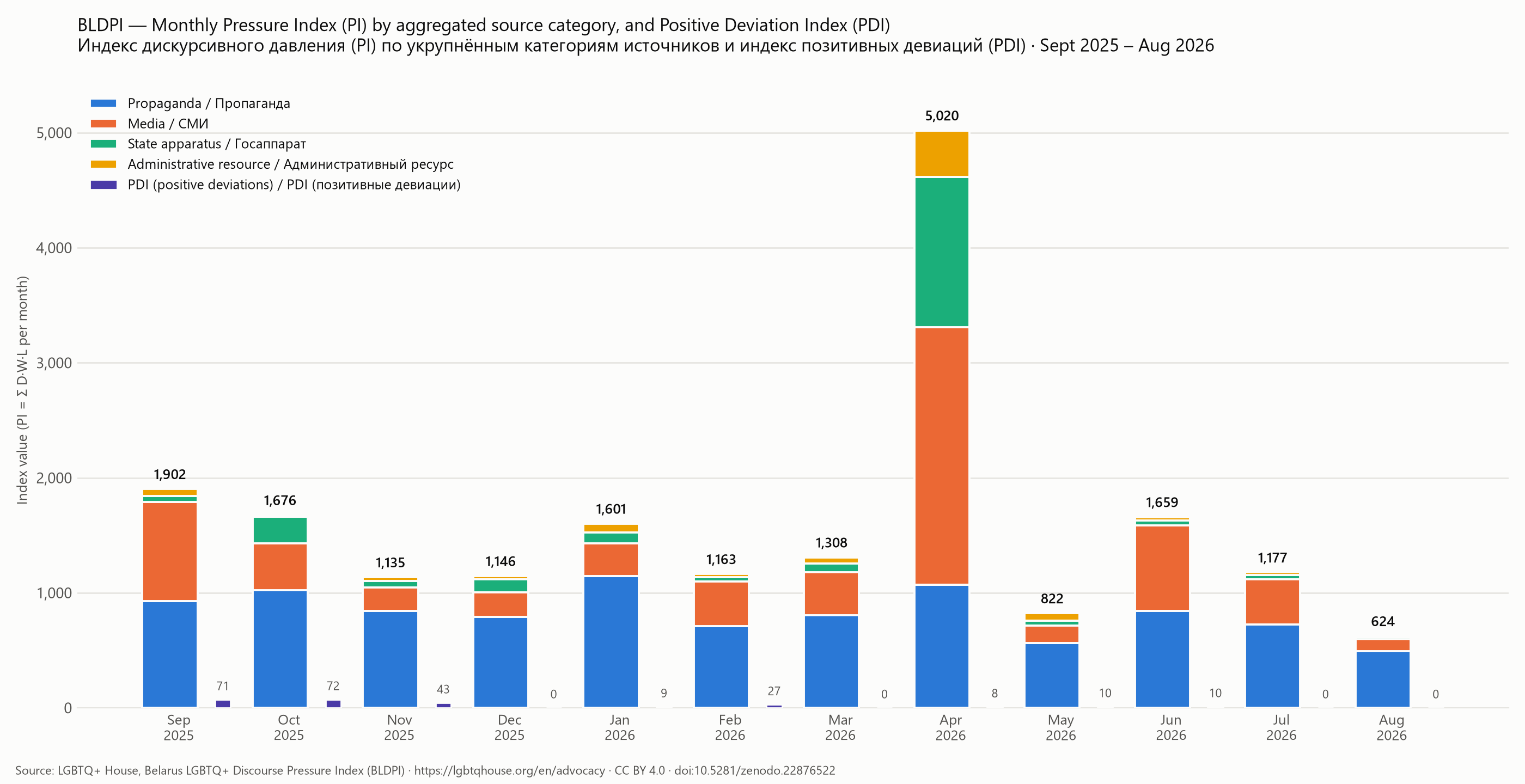
Source: BLDPI, version 2026.08 (BLDPI_chart_monthly_PI_PDI.png). Number of negative messages by month — Table 7.
In April, the month the law was adopted, PI grew by 283.8 % compared with March; the contribution of state bodies was 1 308 points versus 73, media 2 237 versus 374, administrative resource (pro-government public organisations and state enterprises) 403 versus 55, and propaganda channels 1 072 versus 806. The share of propaganda channels fell from 62 to 21 %: the main contribution to discursive pressure came from state-body channels and the media category. In May, one month after adoption, PI fell to 822 points — the lowest since observation began at that time (the previous low was 1 135 in November 2025), and the number of negative messages also reached a minimum (146). In June, the month the provision entered into force, there was a second surge, three times smaller than April’s (1 659), mainly due to media (742 versus 151 in May, about 71 % of the increase); the contribution of state bodies remained small (40 points). In July and August, PI declined, and in August a new low for the series was recorded: 624 points and 111 negative messages, with the media contribution 108 versus 2 237 in April; the largest share of the index was again accounted for by propaganda channels (62–79 %). In April, the unweighted number of negative messages also increased: from 212 to 426 (Table 7). The growth in PI therefore cannot be explained by weights alone; its magnitude also depends on coding intensity, source composition and the reach multiplier. Without the category of courts, which has the highest weight, the April PI would have been 4 438 points, growth compared with March of 239 %.
The breakdown into nine categories shows which sources drove the April increase. Regional media contributed 1 564 points, compared with 208 in March (76 channels with relevant posts), national media 673 compared with 166, courts 582 compared with 0 (posts about the new law were published by 42 court channels at different levels), executive authorities 448 compared with 73, security agencies 278 compared with 0, state-owned enterprises 301 compared with 22, and pro-government public associations 102 compared with 33; tabloid publics and personal propaganda channels grew more modestly (732 compared with 528 and 340 compared with 278).[79] About 62 % of the April PI (3 106 of 5 020 points, 208 posts) fell on two days — 15 April, the day the law was signed, and 16 April. Among media, the largest contributions came from the channels SB.BY, Sputnik Belarus, NEWS.BY, ONT NEWS and STV; among regional media, from “Strong News”, Newgrodno.by and “Minsk. The Main Thing!”; among state bodies, from the Council of the Republic; among propaganda channels, “ZhS Premium” and Azaryonok’s channel made the top ten.[80] In June, the renewed increase was driven by Sputnik Belarus, NEWS.BY and regional media, against a continued backdrop of tabloid publics.
The index peaks in April and June coincided with the adoption of the law and the entry into force of the provision; in April, the contribution of channels of state bodies and media grew particularly strongly, while between the peaks and after them propaganda channels accounted for the largest share of the index. This is consistent with the hypothesis that state and media channels intensified the information support accompanying legislative changes. In July, the contribution of the media category fell to 392 points, and in August to 108, the lowest value in the series; monthly aggregates do not make it possible to establish the reasons for the dynamics, the degree of coordination of publications, or its connection with the intensity of law enforcement. The data are consistent both with the end of the information campaign and with editorial teams themselves avoiding the topic, since the provision contains no exception for news coverage; the index cannot distinguish between these explanations (section 7). A decline in the negative weighted index does not mean a decline in all mentions of LGBTQ+ issues. PI measures the intensity and structure of discourse within the observation frame, not the number of cases of persecution and not people’s safety: a decline in PI does not allow conclusions to be drawn about changes in the number of requests for help. TG House data cover several months and do not form a comparable month-by-month series.
4.3 Related events during the period
Article 24.62 has been in force since 19 June. The regime of extremist materials, through which subscriptions to LGBTQ+ resources are pursued, continued to expand: in the second quarter of 2026 the list exceeded 10 000 entries[81], in June more than 50 sets of Telegram stickers were added to it, and by 30 June the Ministry of Internal Affairs (MVD) list contained 373 entries.[82][83] Resolution of the Council of Ministers No. 274 of 1 June 2026 approved a new version of the Regulations on the National Council on Gender Policy; the Regulations use the concepts of “spiritual and moral family values, motherhood and fatherhood” and do not mention LGBTQ+ people.[84]
4.4 Response of international mechanisms
The communication from six UN mandate holders dated 3 December 2025 concerned the draft law and contained three questions to the government; as at 21 September 2026, Belarus's response had not been published in the communications register.[85] The statement by seven mandate holders dated 15 April 2026 called the adopted law a “dangerous escalation” and called for “the implementation of the law to be halted and the discriminatory provisions repealed”.[86] Report A/HRC/62/52: “the situation of LGBTQ+ people in Belarus is deteriorating … transgender people face additional barriers, particularly in access to healthcare and legal gender recognition” (paras. 53–55); in the oral statement on 29 June 2026, LGBTQ+ people were named among the groups whose persecution is preventing the number of political prisoners from falling.[87] The report of the Group of Independent Experts (GIE) dated 14 September 2026 on the criminal justice system does not examine the situation of LGBTQ+ people separately and, regarding the prison hierarchy, refers to report A/HRC/61/57.[88] The EU statement at the 62nd session of the Human Rights Council does not mention the law on “propaganda”.[89] No analysis of the application of Article 19.16 after its entry into force was identified in the published documents of UN mechanisms reviewed; the materials being submitted can supplement the public evidentiary base and link reports about practice with the legal assessments already expressed.
5. Access to information
Table 8. Channels of access to information before and after 19 June 2026
| Channel | Before 19.06.2026 | What Article 19.16 added | What is technically possible and with what risk | Source / status |
|---|---|---|---|---|
| Independent media on LGBTQ+ | TG House, DazHip and Prismatica resources on the list of extremist materials; prosecution for subscribing | liability for reposting and forwarding any material recognised as “propaganda” | reading without subscribing via a VPN; risk during a device check | D1/D2 · lists — court decisions; persecution — TG House reports |
| Books | 258 publications are included in a list restricting their distribution | distribution of a book with an “attractive” depiction of LGBTQ+ people may meet the elements of an administrative offence | private reading; electronic publications outside jurisdiction; risk during device inspection | D1/D3 · Ministry of Information list; practice — Human Constanta analysis |
| Personal accounts | doxxing, “confession videos”, Article 343 for photographs | risk of publications being classified as dissemination of information with the aim specified in the Article | anonymous accounts; deletion of archives recommended by BHC and TG House; risk is not excluded | D2, D1, R · practice — TG House, A/HRC/59/59; characterisation — BHC assessment |
| Schools | Article 37-1 of the Law "On the Rights of the Child" from January 2026 | risk of application of part 2 where a minor is exposed to information covered by the provision | no legal channel of information for adolescents was identified in the sources reviewed | R, N · risk assessment; no cases found |
| Medical information | according to TG House, the procedure is accompanied by one authorised doctor; detailed guidance on the gender transition procedure has been published by TG House, a resource on the National List of Extremist Materials | discussion of the transition procedure as “propaganda of sex change” | appointment with an authorised doctor; foreign consultations are available remotely; risks depend on the status of the resource used, the method of contact, and the possibility of third parties accessing the device | D3, N · procedure — TG House reports; HIV prevention — no data found |
| Legal information | the websites of the Belarusian Helsinki Committee (BHC) and Human Constanta and the Telegram channel “Legal Initiative” are on the National List of Extremist Materials; the Belarusian Helsinki Committee (BHC) and Human Constanta are on the Ministry of Internal Affairs (MVD)'s list of extremist formations | an analysis of the norm exists; contact with the author entails legal risk | Legal Hub in an anonymous contact format; no published defence practice under the norm was found | D1/D3 · lists — official decisions; services — reports by organisations |
| Culture | festival cancellations; book lists | “paintings at exhibitions and theatre performances” are expressly named by the BHC as covered by the provision | artistic expression is possible in exile (illustration: Prapahanda exhibition, Warsaw, 12–21 August 2026); this does not make it accessible inside the country[90] | R, D4 · BHC assessment; example — illustration |
| Community communication | dating chat on the list of extremist materials; sting dates | risk of applying Part 1 to the dissemination of information in a community | closed groups outside Belarusian platforms; risk during a device check | D2 · TG House messages |
Sources: Table 5; BHC and Prismatica, 15.04.2026; TG House, 2025 monitoring; Human Constanta; Prapahanda.
Alongside the pre-existing restrictions, Article 19.16 introduces a separate basis for liability for disseminating information with the purpose specified in the Article, which does not require the prior inclusion of the material or resource in an official list. For a person inside the country, obtaining information about themselves is associated with a risk during a device check, and disseminating it may be classified as an offence at the discretion of the law-enforcement authority.[91][92]
6. Access to support
6.1 Legal assistance
According to TG House’s assessment in its report for the 2025 UPR, previously operating LGBTQ+ organisations have been liquidated, and specialised legal assistance inside the country is substantially restricted.[93] The Belarusian Helsinki Committee (BHC) and Prismatica’s analysis of the adopted provision begins with a warning: “the BHC website has been recognised as extremist materials, and the BHC itself as an extremist formation. Take precautions”.[94] Legal Initiative also published an overview of the laws and risks.[95] The Belarusian human rights initiative Legal Hub offers anonymous consultations; Viasna provides legal support from abroad. Since 2020, at least 141 lawyers have been stripped of their licences.[96] No published defence practice under Article 19.16 was found in the sources reviewed; a mitigating circumstance under Article 7.2 of the Code of Administrative Offences is “voluntary cessation of unlawful behaviour”, that is, removal of the information. At the same time, a Viasna lawyer points to the possibility of requesting a copy of the ruling from the body that issued it and restoring an appeal deadline missed through no fault of the person concerned; the applicability and safety of these steps require an individual legal assessment.[97] International individual complaints mechanisms are limited: following the denunciation of the First Optional Protocol, the Human Rights Committee does not accept new communications against Belarus[98]; the Committee on the Elimination of Discrimination against Women remains competent under the 2004 Optional Protocol, but its subject matter is limited to discrimination against women: it is relevant for lesbians, bisexual and transgender women and for the provision on “propaganda of childlessness”. Belarus does not implement the Committees’ Views.
6.2 Psychological assistance
UN experts, citing civil society organisations, note an increase in requests for psychological assistance.[99] TG House monitoring describes the persecution of psychologist and activist Marina A., detained by the KGB on 29 April 2025; she scaled back her practice and left.[100] According to a TG House survey of 21 February 2026, as interpreted by TG House, about 80 % of respondents have practised self-censorship since the authorities began discussing discriminatory laws, while 11 out of 21 (52.4 %) assess state policy as creating a threatening atmosphere (n = 21)[101]; according to the survey of 25 February 2026 (n = 21), only 6 out of 21 (28.6 %) can live fully openly.[102] There are no data on the number of psychologists working with LGBTQ+ clients or on the provision’s impact on online counselling. A Moscow study points to a possible mechanism of harm to mental health[103]; no Belarusian measurements could be found.
6.3 Medical care for transgender people
The gender transition procedure is legal and is regulated by Ministry of Health Resolution No. 163 of 9 December 2010, as amended in 2025.[104] According to the text of the resolution, the medical indication is a diagnosis of “Transsexualism” (F64.0); the examination is conducted over the course of a year in three stages at designated healthcare organisations; the decision is made by an interdepartmental commission under the Ministry of Health, which meets at least once every six months; by Resolution No. 100 of 10 September 2025, the sexologist on the commission and in the instructions was replaced by a psychiatrist-narcologist (in force from 18 September 2025); the resolution does not establish a procedure for appealing the commission’s decisions.[105] In practice, according to TG House, applicants go through two commission stages: a decision on changing documents and admission to medical transition.[106] TG House monitoring for 2019–2024 shows an overall share of refusals at meetings ranging from 0 to 41 % in 2019–2022, 80 % in September 2023, and 78 and 68 % in 2024.[107] For legal gender recognition, TG House reports refusals for 20 out of 25 applicants in June 2025 (80 %), 20 out of 28 in December 2025 (about 71 %) and 19 out of 29 in June 2026 (about 66 %); at the medical stage, refusals were received by 2 out of 5, 0 out of 8 and 0 out of 6 respectively.[108][109] These are monitoring data on specific meetings, not official statistics; the lower share of refusals in 2026 does not mean improved access, since the composition of applicants and access to the meeting itself are unknown. The Ministry of Health refused to provide official statistics as “restricted-distribution official information”. TG House reports opacity in decision-making, a lack of explanations for refusals and the absence of an effective appeal mechanism; the procedure is handled by a single authorised psychiatrist-narcologist in Minsk, and that doctor’s absence stops the process “for hundreds of transgender people across the country”.[110] Two independent sources identify the consequence: the Coalition of Fem-Queer Initiatives speaks of coercion “into unsafe self-medication”[111]; Salidarnasts describes illegal hormone therapy and its risks.[112] UN experts note that the law “has also raised fears for transgender persons regarding access to medicines”.[113] As early as 2018, the Human Rights Committee raised with Belarus the sex digit in the identification number and category 19a in military ID cards[114]; TG House has since documented 12 cases of identification by the passport digit and 5 cases of category 19a.[115] Article 19.16 creates an additional risk that information about the procedure will be classified as “propaganda”: a detailed Russian-language guide to undergoing transition has been published by TG House, a resource on the list of extremist materials.
6.4 Assistance with departure and international protection
Departure. According to TG House, in 2025 the organisation helped 12 people to leave; from the start of 2026 to 15 August, eight; of the 24 who applied in May–August 2026, ten had left by 8 September.[116][117] The main obstacle, according to TG House: a humanitarian visa usually requires documents about persecution, but the authorities “in many cases do not issue official decisions or other documents confirming the fact of persecution”; a person needs a visa before being detained, not after.[118]
Border. Since 27 March 2025, a temporary restriction on the right to lodge an application for international protection under Article 33a of the Act of 13 June 2003 on granting protection to foreigners has been in force at the Polish-Belarusian border; the restriction is extended by regulations of the Council of Ministers, the latest of 15 September 2026 for 60 days from 18 September.[119] Under Article 33b(2), the Border Guard accepts applications from unaccompanied minors, pregnant women, persons requiring special treatment on grounds of age or health, persons with unambiguous signs of a real risk of serious harm in the state from which the person directly arrived in Poland, and from nationals of a state applying instrumentalisation. For citizens of Belarus, an exception from the restriction is provided subject to the conditions of Article 33b(2)(5); Article 33b(3) precludes its application in cases of violent crossing of the border in a group and conduct that has entailed the use of coercive measures; Poland’s Ministry of the Interior and Administration (MSWiA), in its reply to the ombudsmen of 28 August 2025, states that each case is considered individually.[120] No data were found on how the exception is applied to citizens of Belarus in practice; in May 2026 the Commissioner for Human Rights (Ombudsman) expressed concern at the measure’s continued application.[121]
Decisions in Poland. According to the Office for Foreigners (UdSC), Poland registers about 90 % of Belarusian applications for protection lodged in Europe. From 2022 to 1 February 2026, the office issued 11 680 decisions to citizens of Belarus, of which 10 930 were positive (852 refugee statuses and 10 078 grants of subsidiary protection), 343 were negative and 407 were decisions discontinuing proceedings; the recognition rate for decisions on the merits was 99 % in 2022, 98 % in 2023, 94 % in 2024 and 94 % in 2025; there were 29, 49, 153 and 112 negative decisions respectively.[122] Eurostat quarterly data show a turning point in the second quarter of 2026 (Table 9).[123] UdSC and Eurostat data are not directly comparable: the former are cumulative from 2022 and include discontinued proceedings, while the latter are quarterly data on first-instance decisions.
Table 9. First-instance decisions on applications by citizens of Belarus for international protection in Poland, 2025-Q1 – 2026-Q2 (excluding discontinued cases)
| Quarter | Decisions | Positive | of which refugee status | Refusals | Refusal rate |
|---|---|---|---|---|---|
| 2025-Q1 | 560 | 525 | 65 | 35 | 6,3 % |
| 2025-Q2 | 495 | 465 | 45 | 35 | 7,1 % |
| 2025-Q3 | 310 | 280 | 25 | 30 | 9,7 % |
| 2025-Q4 | 480 | 470 | 10 | 10 | 2,1 % |
| 2026-Q1 | 380 | 370 | 30 | 10 | 2,6 % |
| 2026-Q2 | 310 | 235 | 205 | 75 | 24,2 % |
Source: Eurostat, migr_asydcfstq (updated 16.09.2026); unit — persons covered by decisions; values are rounded by Eurostat to 5 independently of one another, so the sum of the components may not match the total (for example, 2025-Q2). The refusal rate was calculated by the author as refusals / decisions. The second quarter of 2026 falls within the transition to Eurostat’s updated instructions on asylum statistics; the available metadata do not indicate that this explains the change in Poland’s indicators.[124]
At the same time, the structure of positive decisions changed: in the second quarter of 2026, 205 out of 235 people received refugee status, whereas in previous quarters the number of statuses ranged from 10 to 65, and the bulk consisted of subsidiary protection. UdSC cumulative reports confirm the shift: in January–May 2026, 215 people received refugee status compared with 147 for all of 2025; no explanation was found in the published materials. The monthly values were obtained as differences between the Office’s cumulative reports as at 1 June, 1 July and 1 August 2026 (author’s calculation; revisions between releases are possible)[125]: in June 2026 — 52 refusals, 21 refugee statuses, 4 grants of subsidiary protection and 13 discontinued cases, i.e. refusals accounted for 57.8 % of all outcomes (n = 90) and 67.5 % of decisions on the merits (n = 77); in July — 82 refusals, 10 refugee statuses, 4 grants of subsidiary protection and 12 discontinuances, i.e. 85.4 % of decisions on the merits (n = 96); the cumulative recognition rate for 2026 according to UdSC reports fell from 95 % as at 1 June to 88 % as at 1 July and 79 % as at 1 August. The same June figures were cited by the media based on the Office’s data.[126] According to lawyer Volha Dobrovolskaya, the country information used in her client’s case contained the assessment that “the greatest wave of repression occurred in the first years after the protests”; she objects that the repressive mechanism “continues to operate, only its forms are changing”, and names LGBTQ+ people among groups at particular risk.[127]
The study does not draw a conclusion about the reasons for the rise in refusals or about whether Article 19.16 is taken into account in specific cases: aggregated statistics by citizenship do not contain the grounds for applications, and decisions are not published. The following has been established: the increase in the share of refusals occurred in the second quarter of 2026; the lawyer’s report published in July about the assessment of repression in one case does not establish the date of a change in UdSC’s overall country assessment and does not explain the dynamics of all decisions; none of the available country assessments, including the EUAA report of 12 May 2026, which identifies LGBTQ+ people as a risk group and describes phone checks upon return[128], could have taken into account the practice of applying the adopted provision. According to TG House’s survey of queer migrants in Poland, Lithuania, France and Spain (20 respondents are stated; the distribution by country gives 21), one of the respondents in Poland describes access to hormone therapy while surgeries are unavailable, without specifying the nature of the barrier.[129]
6.5 Support in detention
The UN Group of Independent Experts (GIE), on the basis of its own interviews: LGBTQ+ prisoners are placed in the category of “low social status”, “usually reserved for people convicted for sexual crimes”, with forced cleaning, isolation and punishment cells (para. 30); witnesses report insulting and sexualised comments by staff of penal colonies and the KGB (para. 46).[130] In its 2025 report, the experts described the beating of a transgender woman by officers of the Main Directorate for Combating Organised Crime and Corruption (GUBOPiK), with the use of a stun gun and coercion into a “repentance video” (para. 47).[131] Transgender women are placed in men’s facilities.[132] These data relate to criminal imprisonment and pre-trial detention centres; there are no data on the conditions of administrative detention of LGBTQ+ people. This information is important for assessing the risk of administrative detention provided for by Part 2 of Article 19.16; however, the described conditions of criminal imprisonment cannot automatically be applied to administrative detention.
6.6 Different groups: what is known and what is not
The provision on “propaganda of childlessness” formally applies regardless of the sex of the person disseminating the information, but affects discussion of women’s reproductive autonomy; this aspect is considered in a communication by UN mandates, among whose signatories is the Working Group on discrimination against women and girls.[133] The Coalition of Fem-Queer Initiatives reports pressure from guardianship authorities on lesbian and bisexual women with children, threats of deprivation of parental rights, restrictions on reproductive services for female couples and sexualised violence during arrests[134]; there are no quantitative data. Data on transgender people are the most complete (section 6.3). For assessing the situation of minors, the 2020 recommendations of the Committee on the Rights of the Child are important; a 2024 survey of 21 transgender students covers those who had studied at universities and colleges since 2012 and does not constitute data on adolescents[135]; no data on the impact of Articles 37-1 and 19.16 on schools were found in the sources reviewed. For people in exile, there are assessments of the risk of extraterritorial application[136] and a survey of 20 migrants; no cases of the provision being applied to emigrants’ content were found in the sources reviewed.
7. What remains unknown
Table 10. Data gaps, their significance and the actors capable of closing them
| Gap (N) | Why it matters | Who can close it |
|---|---|---|
| Number of administrative offence records, decisions, fines and arrests under Article 19.16 by parts of the Article | key indicator of enforcement alongside summonses, threats and discontinued cases; currently three cases according to data from one organisation | Belarusian authorities, through questions from UN Special Procedures; monitoring of court websites |
| Criteria for “forming perceptions of attractiveness” in practice | broad or narrow scenario | analysis of the first rulings |
| Selectivity: do state media disseminate information that, if disseminated by private individuals, would be qualified under Article 19.16 | indicator of discriminatory enforcement | Belarus; BLDPI by category |
| Reasons for the decline in the contribution of the media category to the PI in July–August 2026; possible explanations include a change in the editorial agenda and the deterrent effect of the provision | shows whether the deterrent effect of the provision extends to editorial offices | content analysis of media-category channels; BLDPI by category |
| Blocking and removals with reference to Article 19.16 | no cases found; platform reports do not make it possible to isolate Belarus and the Article | Ministry of Information; platforms |
| Cancellations of cultural events with reference to the law | mandate of the Special Rapporteur in the field of cultural rights | Belarusian Council for Culture; PEN Belarus |
| HIV prevention among MSM and transgender people | available ECOM analyses describe the situation before Article 19.16 | ECOM; UNAIDS; WHO |
| Psychological assistance within the country | actual availability | professional communities in exile |
| Schools and teachers: response to Articles 37-1 and 19.16 | source assessments indicate a risk; no confirmed cases of application of the provisions to teachers were found in the materials reviewed | surveys of teachers in exile |
| Lesbians and bisexual women: scale of pressure from guardianship authorities | stated, not measured | Coalition of fem-queer initiatives; UN Working Group |
| Application of the exception under Article 33b, part 2, point 5, to citizens of Belarus at the border | actual accessibility of the procedure | Border Guard; Commissioner for Human Rights (Ombudsman) |
| Reasons for the change in the structure of positive decisions concerning Belarusians in Poland in 2026 | the shift is confirmed by UdSC reports (215 grants of refugee status in January–May 2026 compared with 147 for 2025); the reasons have not been published | Office for Foreigners (UdSC); analysis of decisions |
| Decisions on applications for protection on grounds of sexual orientation and gender identity (SOGI) in Poland, Lithuania and Germany | whether the new ground is taken into account | authorities on request; EUAA |
Source: compiled by the author.
The 2017 study by the Eurasian Coalition on Health, Rights, Gender and Sexual Diversity (ECOM) and subsequent regional reviews describe earlier legal barriers to HIV prevention among LGBT people in Belarus; their findings need to be updated in light of Article 19.16 and the state of services in 2026.[137]
8. Recommendations
The demands addressed to the Republic of Belarus as the primary duty-bearer have been formulated by UN mechanisms and in the UPR and are not duplicated here: repeal of discriminatory restrictions, an end to persecution for lawful expression, and ensuring access to information and assistance. The recommendations below are addressed to actors in third countries, international mechanisms and organisations within their competence and are formulated as risk-reduction measures; none of them guarantees safety. Each is linked to a specific gap in sections 4–7.
8.1 To organisations providing assistance
- Arrange counselling inside the country in a way that reduces the risk of identifying the user: platforms outside Belarusian jurisdiction, without subscription, with instructions on deleting traces of the request from the user’s device; neither the platform, nor a VPN, nor deletion of correspondence are sufficient indicators of safety. Basis: persecution for subscriptions under Article 19.11; monitoring of social networks and checking of devices as methods of identification.
- Maintain a harmonised register of cases of application of Article 19.16 under a common documentation protocol of the documenting organisations: date, region, body, part of the Article, measure, whether an administrative offence record was drawn up, method of identification; with minimisation of the data collected, restricted access and the person’s consent to the transfer of information to third parties. Publish quarterly in aggregated form without data that would allow persons to be identified.
- Ensure access to verified medical information on gender transition and to individual consultations involving medical specialists, choosing methods of dissemination with account taken of the risks of identification and users’ needs, rather than reducing public information as such. Basis: assessment of the risk of publicly available guidance on gender transition being classified as “propaganda”, reports of self-medication.
- Introduce a standard for recording evidence at first contact for future applications for international protection: screenshots, summonses, witness testimony, with copies stored by an organisation outside Belarus with the person’s consent; the method of storage and handling of traces on the device are determined by an individual safety assessment, taking into account the preservation of evidence and the risks of access to it. The absence of an official document does not mean the absence of a well-founded fear of persecution. Basis: six of the 24 people who sought assistance had official documents; UNHCR Guidelines No. 9 and practice summarised by EUAA.
- For Polish organisations: include Belarusian LGBTQ+ applicants in legal-aid programmes when appealing decisions of the Office for Foreigners (UdSC) to the Refugee Board (Rada do Spraw Uchodźców) and further to the Voivodeship Administrative Court in Warsaw. Basis: the increase in refusals in the second quarter of 2026.
8.2 To Polish institutions
- To the Office for Foreigners (UdSC): update the country assessment on Belarus, taking into account Article 19.16, section J of report A/HRC/62/52, the EUAA report of 12 May 2026 and Fact Sheet EUAA/2026/47; treat sexual orientation and gender identity as an independent risk ground in accordance with the judgments of the Court of Justice of the EU (CJEU) in X, Y and Z (C‑199/12–C‑201/12) and A, B and C (C‑148/13–C‑150/13).
- To the Office and the Ministry of the Interior and Administration: state whether the ground of persecution is recorded in the register of decisions, and publish statistics on decisions concerning citizens of Belarus, broken down by grounds, in aggregated form that precludes the identification of small groups, with a description of the quality of classification.
- To the Ministry of Foreign Affairs and consulates: consider issuing a humanitarian visa where risk is documented before detention, accepting evidence from assistance organisations as proof in the absence of official documents.
- To the Commissioner for Human Rights (Ombudsman) and the Border Guard: clarify and monitor the application of the exception in Article 33b, part 2, point 5 to citizens of Belarus, including LGBTQ+ applicants.
- To deputies and the Foreign Affairs Committee of the Sejm: request from the Ministry of Foreign Affairs whether the issue of Article 19.16 has been raised in bilateral and multilateral formats; request from the Ministry of the Interior and Administration statistics on decisions concerning citizens of Belarus, broken down by grounds of persecution.
8.3 To the institutions of the European Union
- To the European External Action Service (EEAS): mention Article 19.16 and its application in EU statements at the 63rd and 64th sessions of the Human Rights Council, relying on the judgment in case C‑769/22 as the EU position on laws of this type.
- EUAA: issue an update to country information on the situation of LGBTQ+ people in Belarus after 19 June 2026.
- To the European Parliament: ask the Commission how Article 19.16 is taken into account in the LGBTIQ Equality Strategy for 2026–2030 and in support programmes for Belarusian civil society.
8.4 To international UN mechanisms
- To the Special Procedures: send the Government of Belarus a communication on the application of the adopted provision, with the participation of the Special Rapporteur in the field of cultural rights, including questions about the number of administrative offence records under the parts of the Article, the criteria of “attractiveness”, selective application, blocking, cancellations of events, the relationship with Resolution No. 24 and the provision of a response to the questions in OL BLR 13/2025, since as of the search date no response had been published in the public register.
- To the Special Rapporteur on Belarus: include the enforcement of Article 19.16 in reports to the 82nd session of the General Assembly and to the 65th session of the Human Rights Council.[138] To the Group of Independent Experts: continue analysing the situation of LGBTQ+ people in the report to the 64th session of the Council, supplementing the findings in A/HRC/61/57 with information on the application of Article 19.16.
- To the treaty bodies: during the next review of Belarus, request implementation of the recommendations in CCPR/C/BLR/CO/5 (paras. 19–20), CRC/C/BLR/CO/5-6 (paras. 15, 21, 34) and CEDAW/C/BLR/CO/9 (para. 30) in the light of Article 19.16; during consideration of Belarus’s next periodic report by the Committee on the Elimination of Discrimination against Women, submit materials on the application of the provision on “propaganda of childlessness” and on the situation of lesbian, bisexual and transgender women, without prejudging the admissibility of individual complaints.
8.5 To platforms
- Meta, TikTok, Google, Telegram: take into account that the public activity of Belarusian users is used for identification under Article 19.16, and provide Belarusian LGBTQ+ organisations with an accelerated response channel for doxing and “repentance videos” published by pro-government channels.
8.6 To donors and researchers
- Fund the collection of the missing data listed in section 7 in the following order of priority: a register of the application of the provision; application of the exception at the border; HIV prevention; psychological assistance; decisions on applications for protection on the grounds of sexual orientation and gender identity in EU countries. Use methods involving a prior assessment of participants’ safety, minimisation of personal data and the exclusion of contacts that create an unacceptable risk.
- Place research and safe aggregated data with persistent identifiers in open repositories; transmit information about specific individuals to international mechanisms separately, taking into account consent, confidentiality and the conditions of the receiving mechanism, including to the Group of Independent Experts as part of the current call.[139]
Annex A. Chronology
Table 11. Chronology, March 2024 – September 2026
| Date | Event |
|---|---|
| 19.03.2024 | Ministry of Culture Resolution No. 24 classifies “non-traditional sexual relations and (or) sexual behaviour” as “sexual perversions” (published on 11.04.2024, in force from 12.04.2024) |
| 28.03.2024 | First inclusion of resources of an LGBTQ+ initiative in the National List of Extremist Materials (Table 5) |
| 21.11.2024 | First list of banned printed publications (35 titles) |
| 07.02.2025 | First reading of amendments to the Law “On the Rights of the Child” |
| 09.07.2025 | The draft law “On Amendments to the Codes on Matters of Administrative Liability” has been submitted by the Council of Ministers to the House of Representatives |
| 11.07.2025 | Statement by Belarusian human rights organisations against the draft law[140] |
| 12.07.2025 | Law No. 86-Z on the rights of children signed |
| October 2025 | First reading of the draft amendments to legislation on administrative liability |
| 03.11.2025 | Review of Belarus under the Universal Periodic Review (UPR), 50th session |
| 03.12.2025 | Letter from six UN mandates OL BLR 13/2025 |
| 08.01.2026 | Belarus rejects all Universal Periodic Review (UPR) recommendations on sexual orientation and gender identity (SOGI) (A/HRC/61/4/Add.1) |
| 13.03.2026 | Adoption of the law by the House of Representatives at second reading |
| 02.04.2026 | Approval by the Council of the Republic |
| 15.04.2026 | Signing of the law; statement by seven UN mandates; analysis of the provision by the Belarusian Helsinki Committee (BHC) and Prismatica |
| 21.04.2026 | Judgment of the Court of Justice of the EU (CJEU) in case C‑769/22 |
| 12.05.2026 | EUAA report on Belarus |
| 19.05.2026 | Report of the Special Rapporteur A/HRC/62/52 |
| 19.06.2026 | Entry into force of Article 19.16 |
| 25.06.2026 | According to Hera’s account — a summons for questioning “for propaganda”; the story was published on 29.08.2026, the article under which the proceedings were brought was not specified |
| 29.06.2026 | Presentation of the Special Rapporteur’s report at the 62nd session of the Council |
| 15.08.2026 | TG House’s first public report on documented persecution under Article 19.16 (Euroradio) |
| 08.09.2026 | TG House reports three cases under Article 19.16 that it has documented |
| 14.09.2026 | Report of the Group of Independent Experts A/HRC/63/CRP.1 |
| 27.09.2026 | One hundred days of the provision in force |
Source: compiled by the author based on the sources in sections 2–4.
Annex B. Search protocol and scope of review
Databases and websites. The UN Official Document System by symbols A/Human Rights Council, A/79, CCPR, CRC, CEDAW; the database of special procedures communications; mandate pages of the Office of the United Nations High Commissioner for Human Rights (OHCHR) on Belarus; UPR Info; HUDOC; CURIA; the EUAA case-law database; Eurostat; gov.pl; bip.brpo.gov.pl; pravo.by; the websites of TG House, Prismatica, Lawtrend, the Belarusian Helsinki Committee, Human Constanta, Legal Initiative, Viasna, ILGA-Europe, TGEU, Human Rights Watch, Amnesty International, Freedom House, EUAA, ECOM; Meta transparency reports.
Search strategy. UN documents were searched by symbols in the Official Document System and by mandates in the database of special procedures communications; case law — by case numbers in HUDOC, CURIA and the EUAA case-law database; Belarusian acts — by identifying details on the National Legal Internet Portal; official lists — on the websites of the Ministry of Information and the Ministry of Internal Affairs (MVD); statistics — by Eurostat table codes and releases of UdSC reports. On the websites of the listed organisations, publications for 2024–2026 relating to the research questions were selected. In addition, a full-text search was carried out in Russian, Belarusian, English and Polish across five thematic blocks: norm and legislative process; law enforcement and cases; official lists and restrictions; medical procedure and health; international protection and the border. Period. Documents on events from 1 January 2024 to 21 September 2026 (date of the last search); basic legal acts, international standards, case law and earlier studies were included regardless of date. The BLDPI series through 31 August 2026; dated information on law enforcement within this period, undated reports are presented separately.
Inclusion criteria. Primary documents; publications by organisations with a described methodology or case verification; official statistics; media as carriers of primary data or direct quotations with an indication of the data source. Exclusion criteria. Retellings of the same monitoring in other publications as standalone sources; materials without a date; anonymous Telegram channels as a source of facts. Scope of verification. The following were checked in full text: Law No. 138-Z (Articles 1 and 4), A/HRC/61/4 and Add.1, A/HRC/62/52, A/HRC/61/57, A/HRC/59/59, A/HRC/58/68, A/79/201, CCPR/C/BLR/CO/5, CRC/C/BLR/CO/5-6, CEDAW/C/BLR/CO/9, OL BLR 13/2025, press release No. 59/26 of the Court of Justice of the EU (CJEU), Fact Sheet EUAA/2026/47, UdSC reports, Eurostat extract, Lawtrend monitoring for April 2026, TG House monitoring for 2025 and the review of the first half of 2026, analyses by the BHC and Prismatica, TG House and NGO coalition reports for the Universal Periodic Review (UPR); report A/HRC/63/CRP.1 and the EU statement of 29.06.2026 were studied in full for references to LGBTQ+ topics. Media publications were checked against the primary data indicated in them; quotations were checked against the original, translations are marked. The BLDPI series was checked against the published files of version 2026.08.
How to cite
LGBTQ+ House (2026). Access to information and support under Article 19.16 of the Code of Administrative Offences of the Republic of Belarus: documented restrictions, gaps in assistance and recommendations for organisations and institutions. Warsaw, September 2026, version 1.5. BLDPI series through 31 August 2026; document search completed on 21 September 2026. https://lgbtqhouse.org/article-19-16/research. DOI https://doi.org/10.5281/zenodo.22884584. Licence CC BY 4.0. Dataset: BLDPI 2026.08, https://doi.org/10.5281/zenodo.22876522.
Notes
- LGBTQ+ House, Belarus LGBTQ+ Discourse Pressure Index (BLDPI): monthly PI/PDI series, source-category breakdowns and monthly reports, September 2025 – August 2026, version 2026.08 [dataset], Zenodo, 2026, https://doi.org/10.5281/zenodo.22876522; methodology: https://lgbtqhouse.org/en/advocacy (accessed: 21.09.2026). ↩
- UN Human Rights Council, Report of the Working Group on the Universal Periodic Review: Belarus, A/HRC/61/4, 5 January 2026, recommendations 146.130, 147.7, 147.51, 147.63–147.67, https://docs.un.org/en/A/HRC/61/4; Addendum: views on conclusions and/or recommendations, A/HRC/61/4/Add.1, 8 January 2026, https://docs.un.org/en/A/HRC/61/4/Add.1. ↩
- Special Procedures of the UN Human Rights Council, communication OL BLR 13/2025, 3 December 2025, https://spcommreports.ohchr.org/TMResultsBase/DownLoadPublicCommunicationFile?gId=30573. ↩
- UN OHCHR, “UN experts alarmed by law targeting LGBT, women's rights advocates and independent voices in Belarus”, press release, 15 April 2026, https://www.ohchr.org/en/press-releases/2026/04/un-experts-alarmed-law-targeting-lgbt-womens-rights-advocates-and. ↩
- UN Human Rights Council, Situation of human rights in Belarus: report of the Special Rapporteur, Nils Muižnieks, A/HRC/62/52, 19 May 2026, paras. 9, 53–55, 60, 129, https://docs.un.org/en/A/HRC/62/52; oral statement of 29 June 2026. ↩
- UN Human Rights Council, Situation of human rights in Belarus: report of the Group of Independent Experts (GIE), A/HRC/61/57, 6 February 2026, paras. 13, 30, 44–46, 52, 113, https://docs.un.org/en/A/HRC/61/57. ↩
- TG House, The Monitoring of Repression and Discrimination Against Belarusian LGBTQ+ Community in 2025, Warsaw, 28 January 2026, https://wp.tbelarus.com/wp-content/uploads/2026/01/the-monitoring-of-repression-and-discrimination-against-belarusian-lgbtq-community-in-2025-en.pdf. ↩
- Law of the Republic of Belarus of 15 April 2026 No. 138-Z “On Amending Codes on Matters of Administrative Liability”, Article 1, para. 85, Article 4; National Legal Internet Portal of the Republic of Belarus, 18 April 2026, reg. No. 5-2/3224, https://pravo.by/document/?guid=12551&p0=H12600138 (accessed: 21.09.2026). ↩
- House of Representatives of the National Assembly of the Republic of Belarus, Bills submitted for consideration to the House of Representatives: “On amending the codes on issues of administrative liability”, incoming No. 3323, 09.07.2025, https://house.gov.by/ru/zakony-ru/curr_conv/21/curr_session/98 (accessed: 23.09.2026). ↩
- Resolution of the Council of Ministers of the Republic of Belarus of 20 November 2025 No. 651 “On Establishing the Amount of the Base Value (BV)”, National Legal Internet Portal of the Republic of Belarus, 22.11.2025, No. 6-1/55458 (in force from 1 January 2026); see also https://pravo.by/novosti/novosti-pravo-by/2025/november/91047/. ↩
- National Bank of the Republic of Belarus, official exchange rate of the Belarusian rouble against the euro as at 19 September 2026 (3.4736), https://www.nbrb.by/statistics/rates/ratesdaily. ↩
- Lawtrend, Monitoring of the situation with freedom of association and the situation of civil society organisations in the Republic of Belarus. April 2026, May 2026, https://www.lawtrend.org/wp-content/uploads/2026/05/Monitoring-aprel-2026.pdf. ↩
- UN OHCHR, press release 15.04.2026. ↩
- Resolution of the Ministry of Culture of the Republic of Belarus of 19 March 2024 No. 24 “On amending Resolution of the Ministry of Culture of the Republic of Belarus of 8 May 2007 No. 18”, National Legal Internet Portal of the Republic of Belarus, 11.04.2024, No. 8/41365 (in force from 12 April 2024), https://pravo.by/document/?guid=12551&p0=W22441365. ↩
- Law of the Republic of Belarus of 12 July 2025 No. 86-Z “On amending laws on issues of ensuring children’s rights”, National Legal Internet Portal of the Republic of Belarus, 16.07.2025, No. 5-2/3172; Article 1 para. 21 (second part of Article 37-1 of the Law “On the Rights of the Child”), Article 8 (entry into force six months after official publication), https://pravo.by/document/?guid=12551&p0=H12500086. ↩
- Resolution of the Ministry of Health of the Republic of Belarus of 9 December 2010 No. 163 “On the change and correction of sex”, as amended by Resolution of 10 September 2025 No. 100 (National Legal Internet Portal, 17.09.2025, No. 11-2/43801; in force from 18 September 2025), https://pravo.by/document/?guid=3871&p0=W21023106. ↩
- Belarusian Helsinki Committee (BHC) and Prismatica, “Amendments to the Code of Administrative Offences: what they mean for LGBTQ+ people and childfree people”, 15 April 2026, https://belhelcom.org/ru/news/popravki-v-koap-chto-oni-znachat-dlya-lgbtk-i-chayldfri. ↩
- BHC and Prismatica, 15.04.2026. ↩
- Lawtrend, April 2026. ↩
- UN OHCHR, press release 15.04.2026. ↩
- UN Human Rights Committee, Fedotova v. Russian Federation, communication No. 1932/2010, Views of 31 October 2012, CCPR/C/106/D/1932/2010, https://docs.un.org/en/CCPR/C/106/D/1932/2010. ↩
- UN Human Rights Committee, Nepomnyashchiy v. Russian Federation, communication No. 2318/2013, Views of 17 July 2018, CCPR/C/123/D/2318/2013, https://juris.ohchr.org/casedetails/2546/en-US. ↩
- UN General Assembly, Situation of human rights in Belarus: report of the Special Rapporteur, A/79/201, 19 July 2024, paras. 7, 29–31, https://docs.un.org/en/A/79/201. ↩
- UN Human Rights Committee, Concluding observations on the fifth periodic report of Belarus, CCPR/C/BLR/CO/5, 22 November 2018, paras. 19–20, https://docs.un.org/en/CCPR/C/BLR/CO/5. ↩
- UN Committee on the Rights of the Child, Concluding observations on the combined fifth and sixth periodic reports of Belarus, CRC/C/BLR/CO/5-6, 28 February 2020, paras. 15(a), 20(e), 21(d), 34(b), https://docs.un.org/en/CRC/C/BLR/CO/5-6. ↩
- UN Committee on the Rights of the Child, General comment No. 20 (2016), CRC/C/GC/20, 6 December 2016, paras. 33–34, 60, https://docs.un.org/en/CRC/C/GC/20. ↩
- UN Committee on the Elimination of Discrimination against Women, Concluding observations on the ninth periodic report of Belarus, CEDAW/C/BLR/CO/9, 27 February 2025, para. 30, https://docs.un.org/en/CEDAW/C/BLR/CO/9. ↩
- European Court of Human Rights, Bayev and Others v. Russia, applications nos. 67667/09, 44092/12 and 56717/12, judgment of 20 June 2017, https://hudoc.echr.coe.int/eng?i=001-174422. ↩
- European Court of Human Rights (Grand Chamber), Macatė v. Lithuania, application no. 61435/19, judgment of 23 January 2023, https://hudoc.echr.coe.int/eng?i=001-222072. ↩
- Court of Justice of the European Union, judgment of 21 April 2026, Commission v Hungary, C‑769/22, ECLI:EU:C:2026:326; press release No. 59/26, https://curia.europa.eu/site/upload/docs/application/pdf/2026-04/cp260059en.pdf. ↩
- Court of Justice of the European Union, judgment of 7 November 2013, X, Y, Z, joined cases C‑199/12–C‑201/12, ECLI:EU:C:2013:720, https://eur-lex.europa.eu/legal-content/EN/TXT/?uri=CELEX:62012CJ0199. ↩
- Court of Justice of the EU (CJEU), decision of 2 December 2014, A, B, C, joined cases C‑148/13–C‑150/13, ECLI:EU:C:2014:2406, https://eur-lex.europa.eu/legal-content/EN/ALL/?uri=CELEX%3A62013CJ0148. ↩
- UNHCR, Guidelines on International Protection No. 9, HCR/GIP/12/09, 23 October 2012, https://www.refworld.org/policy/legalguidance/unhcr/2012/en/89548. ↩
- European Union Agency for Asylum (EUAA), Jurisprudence related to LGBTIQ Applicants in International Protection, Fact Sheet EUAA/2026/47, September 2026, https://caselaw.euaa.europa.eu/Documents/2026_factsheet47_case_law_LGBTIQ_applicants_EN.pdf. ↩
- UN Human Rights Committee, General Comment No. 34 (2011) on freedoms of opinion and expression, CCPR/C/GC/34, 12 September 2011, paras. 25, 33–35, https://docs.un.org/en/CCPR/C/GC/34. ↩
- Human Rights Watch, No Support: Russia's “Gay Propaganda” Law Imperils LGBT Youth, 11 December 2018, https://www.hrw.org/report/2018/12/11/no-support/russias-gay-propaganda-law-imperils-lgbt-youth; Human Rights Watch, “Belarus Imports Russia's “Propaganda” Playbook”, 10 April 2026, https://www.hrw.org/news/2026/04/10/belarus-imports-russias-propaganda-playbook; Human Rights Watch, World Report 2026: Belarus, https://www.hrw.org/world-report/2026/country-chapters/belarus. ↩
- CRC/C/GC/20. ↩
- Bayev and Others v. Russia. ↩
- Macatė v. Lithuania. ↩
- C‑769/22. ↩
- A/HRC/61/4; A/HRC/61/4/Add.1. ↩
- Federal Law of the Russian Federation of 23 November 2024 No. 401-FZ “On Amendments to Article 6.21 of the Code of Administrative Offences of the Russian Federation” (in force from 4 December 2024), https://www.consultant.ru/document/cons_doc_LAW_491336/. ↩
- Human Rights Watch. ↩
- Russian Federation: Federal Law of 29 June 2013 No. 135-FZ; Federal Law of 5 December 2022 No. 478-FZ; Supreme Court decision of 30 November 2023. Hungary: Act LXXIX of 2021. Kyrgyzstan: law signed on 14 August 2023 (TGEU, https://tgeu.org/kyrgyzstan-passes-anti-lgbti-propaganda-law/). Bulgaria: amendments to the Pre-school and School Education Act of 7 August 2024 (ILGA-Europe). Georgia: law adopted on 17 September 2024, signed on 3 October 2024 (OHCHR, press release 25 September 2024). Kazakhstan: law signed on 30 December 2025 (Tengrinews, 30 December 2025). ↩
- Hylton, E., Wirtz, A. L., Zelaya, C. E. et al., “Sexual Identity, Stigma, and Depression: the Role of the “Anti-gay Propaganda Law” in Mental Health among Men Who Have Sex with Men in Moscow, Russia”, Journal of Urban Health, vol. 94, No. 3, 2017, pp. 319–329, https://doi.org/10.1007/s11524-017-0133-6; full text: https://pmc.ncbi.nlm.nih.gov/articles/PMC5481210/ (Table 2 and Results). ↩
- Lawtrend, April 2026. ↩
- TG House, Alternative Report by the Civil Society Organization TG House: Universal Periodic Review, Fourth Cycle, Belarus, Warsaw, 7 April 2025, paras. 3, 9–15, 19, 21, 25–26, https://uprdoc.ohchr.org/uprweb/downloadfile.aspx?filename=14773&file=EnglishTranslation. ↩
- Resolution of the Council of Ministers of the Republic of Belarus of 12 October 2021 No. 575 “On measures to counter extremism and the rehabilitation of Nazism”, National Legal Internet Portal of the Republic of Belarus, 14.10.2021, No. 5/49521, para. 1.2, https://pravo.by/document/?guid=12551&p0=C22100575. ↩
- Ministry of Internal Affairs of the Republic of Belarus, list of organisations, formations and sole proprietors involved in extremist activity (version as at 20 August 2026, 377 entries; maintained pursuant to Resolution of the Council of Ministers of 12 October 2021 No. 575), https://mvd.gov.by/ru/news/8642 (list file: https://mvd.gov.by/uploads/news/8642/72b0a138a6d1df7214169df39179eacf9c9b371a.xlsx). ↩
- Lawtrend, April 2026. ↩
- Viasna Human Rights Centre, “Human rights situation in Belarus. June 2026”, 6 July 2026, https://spring96.org/en/news/120651. ↩
- Ministry of Internal Affairs (MVD), list of organisations and formations. ↩
- TG House, Overview of the Situation of the LGBTQ+ Community in Belarus in the First Half of 2026, 29 June 2026, https://tbelarus.com/post/lgbtq-belarus-overview-first-half-2026. ↩
- Ministry of Information of the Republic of Belarus, National List of Extremist Materials (version with court decisions up to 18 September 2026), https://mininform.gov.by/ru/respublikanskiy-spisok-ekstremistskikh-materialov-ru/ (list file: https://mininform.gov.by/uploads/spisok-ekstremistskix-materialov%2026219.doc); List of print publications containing information reports and/or materials whose dissemination may harm the national interests of the Republic of Belarus (current version, 258 titles), https://www.mininform.gov.by/ru/spisok-pechatnykh-izdaniy-soderzhashchikh-informatsionnye-soobshcheniya-i-ili-ru/ (list file: https://www.mininform.gov.by/uploads/Список_вредоносных_печатых_изданий.pdf). ↩
- UN Human Rights Council, Situation of human rights in Belarus: report of the Special Rapporteur, A/HRC/59/59, 2025, paras. 3, 62, 63, 79–81, https://docs.un.org/en/A/HRC/59/59. ↩
- A/HRC/61/57. ↩
- TG House, overview of the first half of 2026. ↩
- A/HRC/59/59. ↩
- TG House, 2025 monitoring. ↩
- BelTA, “The list of print publications banned from distribution in Belarus has been expanded by 17 titles”, 26 May 2026, https://belta.by/society/view/spisok-zapreschennyh-k-rasprostraneniju-v-belarusi-pechatnyh-izdanij-popolnilsja-17-naimenovanijami-782767-2026/. ↩
- Ministry of Information, official lists. ↩
- A/HRC/62/52. ↩
- Nasha Niva, “Who bans books in Belarus — these 22 people”, 10 June 2026, https://nashaniva.com/ru/396663. ↩
- Human Constanta, “Extremist” University and Ten Thousand “Extremist Materials”: an overview of the fight against “extremism” in Belarus for April–June 2026, 10 September 2026, https://humanconstanta.org/en/extremist-university-and-ten-thousand-extremist-materials/ (PDF: https://humanconstanta.org/wp-content/uploads/2026/09/eng_extr_q126.docx.pdf); overview for January–March 2026, https://humanconstanta.org/obzor-borby-s-ekstremizmom-v-belarusi-za-yanvarmart-2026/. ↩
- TG House, 2025 monitoring. ↩
- BLDPI, version 2026.08. ↩
- Prismatica, Belarus LGBTQI+ rights statements, issues January–August 2026, https://prismatica.community/en-us/statements. ↩
- A/HRC/59/59. ↩
- TG House, report to the Universal Periodic Review (UPR). ↩
- TG House, 2025 monitoring. ↩
- A/HRC/61/57. ↩
- Euroradio, “Human rights defenders document first prosecutions under the ‘LGBT propaganda’ article in Belarus”, 15 August 2026, according to TG House, https://euroradio.fm/ru/pravozaschitniki-zafiksirovali-pervye-presledovaniya-po-state-propaganda-lgbt-v-belarusi (English version: https://euroradio.fm/en/human-rights-defenders-document-first-prosecutions-under-belaruss-lgbt-propaganda-law). ↩
- Euroradio, “Law on “LGBT propaganda”: Belarusian security forces are deliberately persecuting queer people”, 8 September 2026, according to TG House, https://euroradio.fm/ru/zakon-o-lgbt-propagande-belorusskie-siloviki-celenapravlenno-presleduyut-kvir-lyudey. ↩
- Euroradio, 15.08.2026. ↩
- Euroradio, “A queer Belarusian woman spoke about threats from security forces and being forced to leave the country”, 29 August 2026, https://euroradio.fm/ru/kvir-belaruska-rasskazala-ob-ugrozakh-silovikov-i-vynuzhdennom-otezde-iz-strany. ↩
- Euroradio, 15.08.2026. ↩
- TG House, 2025 monitoring. ↩
- TG House, 2025 monitoring. ↩
- BLDPI, version 2026.08. ↩
- LGBTQ+ House, BLDPI: message- and channel-level data (extended dataset, not included in the public deposit; available on request from
This email address is being protected from spambots. You need JavaScript enabled to view it. ); aggregates for nine categories — file bldpi_monthly_by_category.csv in the version 2026.08 deposit. ↩ - Human Constanta, Q2 2026. ↩
- Viasna, June 2026. ↩
- Ministry of Internal Affairs (MVD), list of organisations and formations. ↩
- Resolution of the Council of Ministers of the Republic of Belarus of 1 June 2026 No. 274 (new version of the Regulations on the National Council on Gender Policy); Ministry of Labour and Social Protection, https://www.mintrud.gov.by/special/ru/nacionalni_sovet_po_gendernoi_politike-ru. ↩
- OL BLR 13/2025. ↩
- UN OHCHR, press release 15.04.2026. ↩
- A/HRC/62/52. ↩
- UN Human Rights Council, The involvement of Belarusian State institutions in human rights violations in the criminal justice process: report of the Group of Independent Experts, A/HRC/63/CRP.1, 14 September 2026, https://www.ohchr.org/sites/default/files/documents/hrbodies/hrcouncil/sessions-regular/session63/a-hrc-63-crp-1.pdf; oral statement of 18 September 2026. ↩
- European External Action Service, Human Rights Council 62 — EU Statement — Interactive dialogue with the Special Rapporteur on the situation of human rights in Belarus, Geneva, 29 June 2026, https://www.eeas.europa.eu/delegations/un-geneva/hrc-62-eu-statement-interactive-dialogue-special-rapporteur-situation-human-rights-belarus_en. ↩
- Prapahanda, exhibition, Nowe Miejsce, Warsaw, 12–21 August 2026, https://prapahanda.pl. ↩
- Law No. 138-Z. ↩
- BHC and Prismatica, 15.04.2026. ↩
- TG House, report to the Universal Periodic Review (UPR). ↩
- BHC and Prismatica, 15.04.2026. ↩
- Legal Initiative, “The Situation of LGBTQ+ People in Belarus in 2026: Laws, Practice, Risks”, 1 July 2026, https://legin.info/posts/lgbt_belarus_2026. ↩
- Coalition of Belarusian NGOs, UPR-2025: Report of the Coalition of Belarusian NGOs, April 2025, paras. 96–101, https://belhelcom.org/sites/default/files/upr-2025._report_of_the_coalition_of_belarusian_ngos._-_web_compressed.pdf. ↩
- Euroradio, 08.09.2026. ↩
- A/79/201. ↩
- UN OHCHR, press release 15.04.2026. ↩
- TG House, 2025 monitoring. ↩
- TG House, “Silence as a survival strategy: how queer people respond to the Belarusian authorities’ anti-LGBT policy”, 21 February 2026, https://tbelarus.com/en/post/queer-peoples-reaction-to-anti-lgbt-policies. ↩
- TG House, ““Hide who you are or leave”: the challenges queer people face in Belarus”, 25 February 2026 (n = 21), https://tbelarus.com/en/post/queer-safety-survey-2026. ↩
- Hylton et al., 2017. ↩
- Resolution of the Ministry of Health No. 163. ↩
- Resolution of the Ministry of Health No. 163. ↩
- TG House, 2025 monitoring. ↩
- TG House, Monitoring of the work of the gender transition commission in Belarus (2019–2024), 18 December 2024, https://tbelarus.com/post/monitoring-komissii-po-trans-perehodu-v-belarusi-2019-2024; data for 2025–2026 based on the 2025 monitoring and the review of the first half of 2026. ↩
- TG House, 2025 monitoring, pp. 14–15. ↩
- TG House, overview of the first half of 2026. ↩
- TG House, 2025 monitoring. ↩
- Coalition of Fem Queer Initiatives from Belarus, statement for the UPR pre-session, 2025, https://upr-info.org/sites/default/files/country-document/2025-08/Belarus_Coalition_of_Fem_Queer_Initiatives_from_Belarus_statement.pdf. ↩
- Salidarnasts, “Transgender Belarusian woman: “People resort to illegal therapy, and that can ruin their health””, 4 February 2026, https://gazetaby.com/post/transgendernaya-belaruska-lyudi-reshayutsya-na-nelegalnuyu-terapiyu-a-/212219/. ↩
- UN OHCHR, press release 15.04.2026. ↩
- CCPR/C/BLR/CO/5. ↩
- TG House, report to the Universal Periodic Review (UPR). ↩
- Euroradio, 15.08.2026. ↩
- Euroradio, 08.09.2026. ↩
- TG House, 2025 monitoring. ↩
- Act of 13 June 2003 on granting protection to foreigners within the territory of the Republic of Poland, Articles 33a–33b, as amended by the Act of 21 February 2025; Regulation of the Council of Ministers of 27 March 2025 (Dz.U. 2025 poz. 390) and subsequent extensions, the latest of 15 September 2026 (Dz.U. 2026 poz. 1217); Office for Foreigners (UdSC), https://www.gov.pl/web/udsc/ograniczenie-prawa-do-zlozenia-wniosku-o-ochrone-miedzynarodowa. ↩
- Ministry of the Interior and Administration, response to the submission by the Commissioner for Human Rights (Ombudsman) and the Commissioner for Children's Rights, BMP.0790.1.4.2025, 28 August 2025, https://bip.brpo.gov.pl/sites/default/files/2025-08/Odpowiedz_MSWiA_granica_ochrona_miedzynarodowa_28_08_2025.pdf. ↩
- Notes from Poland, «Human rights commissioner concerned that Poland's “temporary” asylum ban still in place one year on», 28 May 2026, https://notesfrompoland.com/2026/05/28/human-rights-commissioner-concerned-that-polands-temporary-asylum-ban-still-in-place-one-year-on/. ↩
- Urząd do Spraw Cudzoziemców, Raport na temat obywateli Białorusi (wg stanu na 1 lutego 2026 r.), https://www.gov.pl/attachment/4738d4ca-beae-459f-b0bb-2db8f2da7ac2. ↩
- Eurostat, First instance decisions on applications by type of decision, citizenship, age and sex — quarterly data (migr_asydcfstq), Poland, citizens of Belarus, 2025-Q1 – 2026-Q2, data updated 16 September 2026, https://ec.europa.eu/eurostat/databrowser/view/migr_asydcfstq. ↩
- Eurostat, Asylum and managed migration — reference metadata (migr_asydec_esms), section 15.2 on the 2026 transition period, https://ec.europa.eu/eurostat/cache/metadata/en/migr_asydec_esms.htm. ↩
- Urząd do Spraw Cudzoziemców, Reports concerning citizens of Belarus (cumulative reports as at 1 June, 1 July and 1 August 2026), https://www.gov.pl/web/udsc/raporty-dotyczace-obywateli-bialorusi; reports as at 01.06.2026 https://www.gov.pl/attachment/be8fbc99-917f-4328-9efc-dbc67b8be152, as at 01.07.2026 https://www.gov.pl/attachment/eea8fd87-82d0-47c5-82bb-09b04f8cbd24 and as at 01.08.2026 https://www.gov.pl/attachment/7089372c-4050-4051-80ad-a7983a4353dc. ↩
- Euroradio, «Poland sharply increases rejections of asylum claims by Belarusians», 17 July 2026, according to the Office for Foreigners (UdSC), https://euroradio.fm/en/poland-sharply-increases-rejections-asylum-claims-belarusians. ↩
- Głos znad Niemna, «Poland is closing itself off to refugees from Belarus», 18 July 2026, https://glosznadniemna.pl/73590/polska-zamyka-sie-na-uchodzcow-z-bialorusi/; Nasha Niva, «Belarusians are increasingly denied international protection in Poland — what's happening», 30 July 2026, https://nashaniva.com/en/400851. ↩
- EUAA, Belarus: Political Opposition and Dissent. Country of Origin Information Report, 12 May 2026, https://www.euaa.europa.eu/publications/coi-report-belarus-political-opposition-and-dissent. ↩
- TG House, “From evacuation to adaptation: the risks faced by queer migrants in the EU”, 5 February 2026 (20 respondents: Poland 8, Lithuania 7, France 5, Spain 1), https://tbelarus.com/en/post/from-evacuation-to-adaptation-queer-migrants-in-europe. ↩
- A/HRC/61/57. ↩
- UN Human Rights Council, Situation of human rights in Belarus: report of the Group of Independent Experts, A/HRC/58/68, 7 February 2025, paras. 38, 39, 47, 58, 59, 62, https://docs.un.org/en/A/HRC/58/68. ↩
- Coalition of Fem Queer Initiatives, 2025. ↩
- OL BLR 13/2025. ↩
- Coalition of Fem Queer Initiatives, 2025. ↩
- TG House, “Invisible scars: transgender students on bullying and discrimination”, 27 September 2024 (21 participants who had studied at universities and colleges in Belarus since 2012), https://tbelarus.com/post/stud-opros-diskr-bulling. ↩
- Legal Initiative, 01.07.2026. ↩
- ECOM — Eurasian Coalition on Health, Rights, Gender and Sexual Diversity, Legislative analysis related to LGBT rights and HIV in Belarus, Tallinn, 2017, https://ecom.ngo/en/library/legislative-analysis-belarus-en/; ECOM, regional review for 2019, 2020, https://ecom.ngo/wp-content/uploads/2020/03/ECOM_regional_2019_en.pdf. ↩
- UN Human Rights Council, resolution 61/26 “Situation of human rights in Belarus”, adopted on 30 March 2026, A/HRC/RES/61/26, paras. 7–8 (reports of the Special Rapporteur to the 65th session of the Council and the 82nd session of the General Assembly; oral report of the Group of Independent Experts at the 63rd session and full report at the 64th session), https://docs.un.org/en/A/HRC/RES/61/26; see the outcomes of the 61st session, https://www.ungeneva.org/en/news-media/meeting-summary/2026/03/le-conseil-des-droits-de-lhomme-acheve-les-travaux-de-sa-61eme. ↩
- OHCHR, Call for submitting information to the Group of Independent Experts on the human rights situation in Belarus: deadline for submissions 30 November 2026, https://www.ohchr.org/en/hr-bodies/hrc/gie-belarus/index/call-submitting-information-group-independent-experts-human-rights-situation-belarus (accessed: 22.09.2026). ↩
- Statement by organisations of the Belarusian human rights community on the inadmissibility of criminalising freedom of expression and discrimination against LGBTQ+ people, 11 July 2025, https://www.lawtrend.org/social-actions/zayavlenie-organizatsij-belarusskogo-pravozashhitnogo-soobshhestva-o-nedopustimosti-kriminalizatsii-svobody-vyrazheniya-i-diskriminatsii-lgbtk-lyudej. ↩