Advocacy brief
Article 19.16: 100 days. What happened to LGBTQ+ people’s access to information and assistance in Belarus and what solutions are needed now

About this document
What UN mechanisms, EU institutions, host states, international organisations and research centres can do: targeted recommendations, questions to the Government of Belarus and suggested wording for statements and parliamentary questions. All facts come from the LGBTQ+ House study.
Contents
- 1. The problem and three solutions
- 2. What is known about the first months of the provision being in force
- 2.1 The provision
- 2.2 Reports of enforcement
- 2.3 Information support for the law: BLDPI data
- 2.4 Access to international protection
- 2.5 What data need to be obtained
- 3. European Union and European Parliament
- 3.1 European External Action Service, EU Delegation in Geneva, permanent representations of Member States
- 3.2 Members of the European Parliament
- 3.3 European Union Agency for Asylum (EUAA)
- 4. UN mechanisms
- 4.1 Special procedures and the Special Rapporteur on Belarus
- 4.2 Group of Independent Experts (GIE) on Belarus
- 4.3 Treaty bodies and states that made recommendations in the Universal Periodic Review (UPR)
- 4.4 UNHCR
- 5. Poland and other host countries
- 5.1 Office for Foreigners (UdSC)
- 5.2 Ministry of the Interior and Administration (MSWiA) and UdSC
- 5.3 Ministry of Foreign Affairs and consulates
- 5.4 Commissioner for Human Rights (Ombudsman) and the Border Guard
- 5.5 Members of the Sejm
- 5.6 Lithuania, Germany and other host countries
- 6. International organisations
- 6.1 What we ask of everyone
- 6.2 What we ask of specific organisations
- 6.3 Universities and research centres
- 6.4 Additional actions by international mechanisms, organisations and platforms
- 7. Ready-made wording for addressees
- 7.1 Paragraph for an EU statement (Human Rights Council, OSCE, European Parliament resolution)
- 7.2 Questions for written answer (Rule 144)
- 7.3 Questions to the Government of Belarus for a special procedures communication and the report of the Group of Independent Experts
- 7.4 Questions for an interpellation or parliamentary question in the Sejm
- 7.5 One sentence for statements by organisations
- 8. Sources, data limitations and contact
- Annex. Draft questions for parliamentary interpellations (PL)
- Notes
1. The problem and three solutions
Article 19.16 of the Code of Administrative Offences of Belarus has been in force since 19 June 2026: there are reports of its application, while the scale of persecution and the availability of assistance remain opaque. The provision penalises the dissemination of information “with the aim of forming among citizens perceptions of the attractiveness” of homosexual relationships, gender reassignment or childlessness; the aim is established by the law-enforcement authority, and the concept of “attractiveness” is not defined in the law.[1] Belarus’s response to the communication by six UN special procedures mandate holders OL BLR 13/2025 of 3 December 2025 had not been published in the public register as at 21 September 2026.[2] On 15 August 2026, the TG House initiative publicly reported that it had already documented persecution under Article 19.16; on 8 September — three cases confirmed by it, 24 requests for assistance in May–August and ten people who had left with its help.[3][4] The share of refusals of international protection to citizens of Belarus in Poland increased from 2.6 % in the first quarter of 2026 to 24.2 % in the second.[5]
The campaign’s main demand of the Belarusian authorities is to repeal Article 19.16, end persecution for lawful expression of opinion, and ensure access to information and assistance. The following actions are proposed for international mechanisms and states.
- UN mechanisms: follow-up action on the adopted and applied provision. For the Special Procedures — a communication to the government of Belarus on the application of Article 19.16, with the involvement of the Special Rapporteurs on freedom of opinion and expression and in the field of cultural rights (questions — section 7.3); for the Special Rapporteur on Belarus — the application of the provision in reports to the 82nd session of the General Assembly and the 65th session of the Council; for the Group of Independent Experts — to take into account the study, BLDPI data and official lists in preparing subsequent findings.
- To the European Union: include the demand for the repeal of Article 19.16 and an end to persecution in EU positions — in the next relevant statements, including the Warsaw Human Dimension Conference on 5–15 October 2026, and in positions on the consideration of the reports of the Group of Independent Experts at the 64th session and of the Special Rapporteur on Belarus at the 65th session of the Council (paragraph — section 7.1); to Members of the European Parliament — written questions under Rule 144 (section 7.2).
- To Poland and other host countries: up-to-date risk assessment and access to protection. Update country information to take account of Article 19.16; treat sexual orientation and gender identity as an independent risk ground; determine whether these grounds are recorded in statistics, and publish aggregated data; consider humanitarian visas where there is a documented risk before detention.
What we provide. The study (RU, EN, BE) with links to sources, the open BLDPI dataset with methodology, the transfer of BLDPI data to the Group of Independent Experts; links and identifiers — section 8. We invite organisations to join the open appeal ‘For the right of LGBTQ+ people in Belarus to information and protection’ (section 6.1).
2. What is known about the first months of the provision being in force
Below are only the facts on which the requests in sections 3–6 rely. The full legal matrix, chronology and analysis of sources are in the study, sections 2–7.[6] The BLDPI data are provided as at 31 August 2026, and the documents as at 21 September 2026.
2.1 The provision
Article 19.16, “Propaganda of homosexual relations, sex change, childlessness, paedophilia”, was introduced by Law No. 138-Z of 15 April 2026 and has been in force since 19 June 2026.[7] Part 1 penalises the dissemination of information “for the purpose of forming among citizens ideas about the attractiveness of homosexual relations, sex change, childlessness, or about recognising paedophilia as acceptable”, regardless of the recipient’s age; Part 2 covers the same act where it results in the exposure of a minor. For individuals, Part 1 provides for a fine of up to 20 base values (BV); Part 2 provides for a fine of 20–30 base values, community service or administrative detention for up to 15 days. For legal entities, the fine is 100–150 base values under Part 1 and 150–200 under Part 2. In addition to the five restrictions previously in force, the article introduces an independent ground of liability that does not require the prior inclusion of the material or resource in an official list. The legislation contains no definitions of “homosexual relations”, “childlessness” or “attractiveness”; the Belarusian Helsinki Committee (BHC) describes a broad application scenario in which the mere availability of information is considered to be “forming ideas”, and a narrow one requiring a call to perceive the phenomenon as the norm.[8] The same law introduced Article 24.62 on “illegal representation of the Republic of Belarus at international events”, which, according to UN experts, may be applied to those engaging with the UN.[9]
A legal assessment of the provision has already been made. On 15 April 2026, seven UN mandates called the adopted law a “dangerous escalation” and called for it not to be brought into force.[10] Belarus supported none of the eight Universal Periodic Review recommendations on sexual orientation and gender identity; all eight were noted in the UPR outcome.[11] The Committee on the Rights of the Child, in its 2020 concluding observations, recommended that Belarus provide sexuality education with attention to sexual orientation and gender identity[12]; general standards on adolescents’ access to information are set out in General Comment No. 20.[13] Similar restrictions have been examined by courts in cases against Russia, Lithuania and Hungary: the European Court of Human Rights in Bayev and Others v. Russia and Macatė v. Lithuania and the Court of Justice of the EU (CJEU) on 21 April 2026 in Commission v Hungary (C‑769/22) rejected the justification of such restrictions on the grounds of protecting children; for Belarus, these decisions are of comparative significance.[14][15][16] In published EU statements on Belarus at the 62nd session of the Human Rights Council and at the dialogue with the Group of Independent Experts (GIE) on 18 September 2026, Article 19.16 is not expressly named.[17][18] We propose including its application and the demand for repeal in subsequent EU positions.
2.2 Reports of enforcement
On 15 August 2026, the TG House initiative publicly reported that it had already documented persecution under Article 19.16.[19] In a publication of 8 September, the organisation reported three cases confirmed by it; the dates and nature of the measures (summons, administrative offence report, fine, arrest) were not disclosed; other cases are also known, but have not yet been documented. In May–August, the organisation received 24 requests for assistance from LGBTQ+ people reporting persecution, threats or the risk of repression; by 8 September, ten of those who had contacted it had left with its help, and six out of the 24 had an official document concerning persecution.[20] Separately, the testimony of Hera, aged 23, was published: on 25 June 2026, six days after the provision entered into force, she was summoned for questioning “for propaganda of non-traditional values”, her phone was seized without procedural documents with reference to activity on TikTok, and she left in July; the article under which proceedings were conducted was not specified in the publication.[21] According to TG House, the method of identification is targeted monitoring of Instagram, TikTok and YouTube and checks of phones when a person is detained on any grounds.[22][23] No publicly available official statistics on the article, published court decisions, blocking measures referring to the article or cases involving the prosecution of legal entities were found in the open sources reviewed.
The provision arrived in an environment where access to information and assistance had already been narrowed. Registered LGBTQ+ organisations have been liquidated; by court decisions, the resources of six LGBTQ+ initiatives and activists, a dating chat and the websites of two human rights organisations have been included in the National List of Extremist Materials, and subscribing to them and storing them are prosecuted under Article 19.11 of the Code of Administrative Offences; TG House documents three such cases in the first half of 2026.[24][25] In 2026, Human Constanta and the Belarusian Helsinki Committee were included in the Ministry of Internal Affairs (MVD) list of extremist formations; participation in a formation is punishable under Article 361-1 of the Criminal Code.[26] Since 2020, at least 141 lawyers have been deprived of their licences; no published defence practice under Article 19.16 was found.[27] Legal gender recognition is lawful, but an interdepartmental commission refused 20 out of 25 applicants in June 2025 and 20 out of 28 in December 2025.[28], and 19 out of 29 — in June 2026.[29] A decrease in the share of refusals at individual sittings does not in itself indicate improved access to the procedure. Ministry of Health Resolution No. 163 does not provide for a special procedure for appealing commission decisions; TG House reports the absence of an effective appeal mechanism.[30][31]
2.3 Information support for the law: BLDPI data
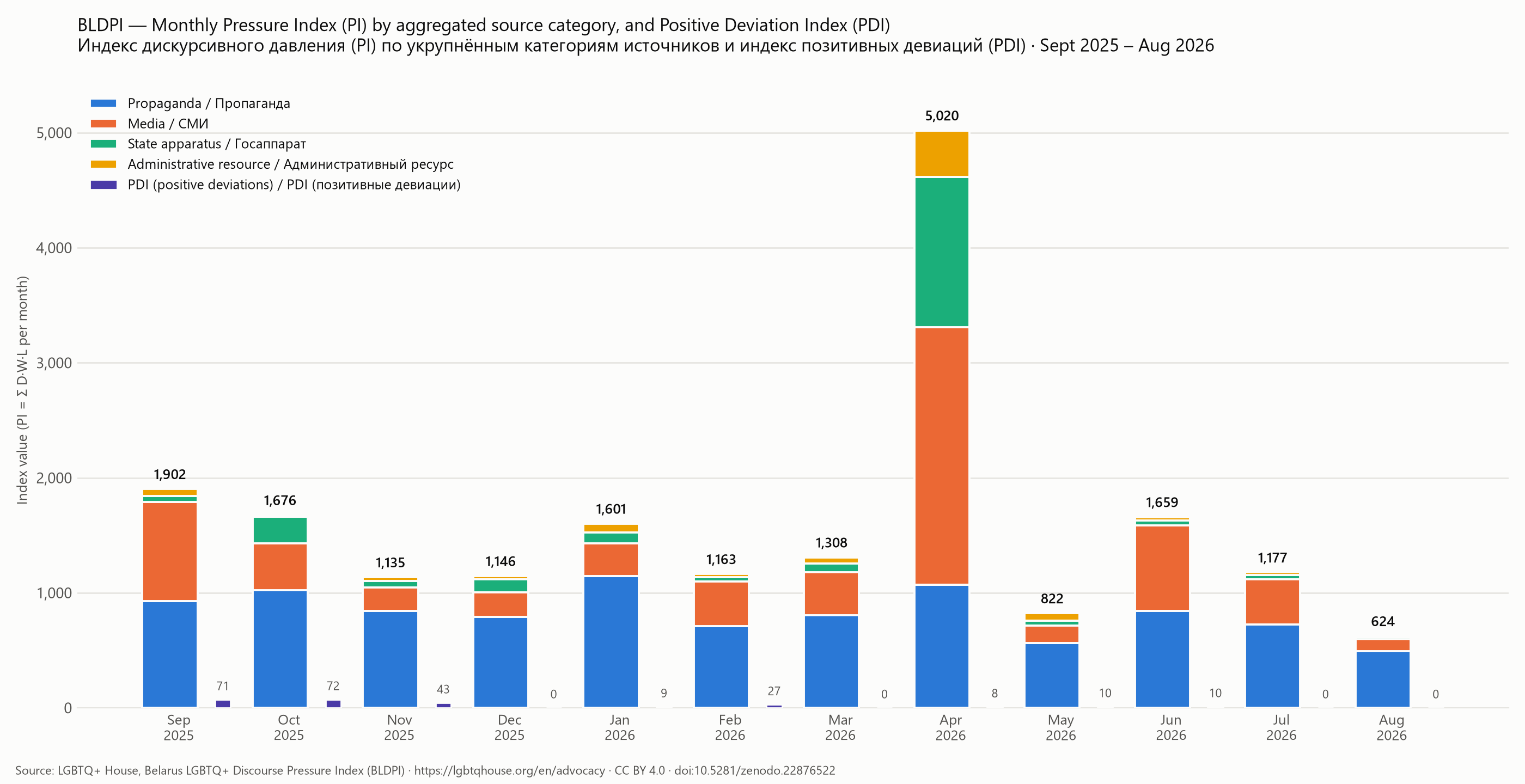
Figure 1. BLDPI, September 2025 – August 2026: Pressure Index (PI) by source category and Positive Deviation Index (PDI)
Source: BLDPI, version 2026.08, DOI 10.5281/zenodo.22876522.
Belarus LGBTQ+ Discourse Pressure Index (BLDPI) — LGBTQ+ House’s own data. The BLDPI documents the information coverage accompanying the adoption of the law: a sharp rise in discursive pressure in April 2026, an increased contribution from state bodies and media, and the concentration of about 62 % of the April index value on 15–16 April, immediately around the signing of the law. The index measures discursive pressure on LGBTQ+ people in 520 public Telegram channels edited from within Belarus; every included message is checked manually, and a message’s contribution depends on its intensity, the institutional weight of the source and its audience.[32] In April 2026, the month the law was adopted, the index rose by 283.8 % compared with March (5 020 versus 1 308 points); the contribution of state body channels rose from 73 to 1 308 points, and that of the media category from 374 to 2 237; messages about the law were published by 42 court channels. In May the index fell to its lowest level since observations began (822). In June (1 659), propaganda channels made the largest contribution to the index value (845 points), while the increase compared with May was driven by the media category (742 versus 151; state bodies — 40). In August the index reached a new low (624). The peaks coincided with the signing of the law and the entry into force of the provision; the readings of the draft law in parliament did not produce comparable peaks. The index measures discourse, not people’s safety.
2.4 Access to international protection
Table 1. First-instance decisions on applications by citizens of Belarus in Poland (Eurostat, excluding discontinued cases)
| Quarter | Decisions | Positive | of which refugee status | Refusals | Refusal rate |
|---|---|---|---|---|---|
| 2025-Q4 | 480 | 470 | 10 | 10 | 2.1 % |
| 2026-Q1 | 380 | 370 | 30 | 10 | 2.6 % |
| 2026-Q2 | 310 | 235 | 205 | 75 | 24.2 % |
Source: Eurostat, migr_asydcfstq (updated 16.09.2026); values rounded to the nearest 5.
Poland considers around 90 % of Belarusian applications for protection in Europe; in 2022–2025 the recognition rate remained at 94–99 %.[33] In the second quarter of 2026, the refusal rate rose to 24.2 %, and the composition of positive decisions changed: 205 grants of refugee status out of 235, compared with 10–65 in previous quarters. A calculation based on the differences between UdSC cumulative reports as at 1 June, 1 July and 1 August 2026 (LGBTQ+ House calculation) shows 82 refusals out of 96 decisions on the merits in July 2026 — 85.4 %; the cumulative recognition rate for 2026 fell from 95 % on 1 June to 79 % on 1 August.[34] These figures relate to citizens of Belarus as a whole; no breakdown by grounds of sexual orientation and gender identity has been published. UdSC monthly figures and Eurostat’s quarterly series are different series and do not form a single sequence. These changes require an explanation from UdSC and clarification of how current risks for LGBTQ+ people are taken into account in country information and individual decisions. A lawyer handling cases of Belarusians cites, from the country information in one case, the assessment that “the largest wave of repression occurred in the first years after the protests”.[35] At the border, a restriction on the right to lodge an application for protection has been in force since 27 March 2025, with the latest extension made by a regulation of 15 September 2026; an exception under Article 33b(2)(5) is provided for citizens of Belarus, but no publicly available data on its application have been found.[36] The EUAA report on Belarus of 12 May 2026 identifies LGBTQ+ people as an at-risk group and describes phone checks upon return, but was drafted before the provision entered into force; Fact Sheet EUAA/2026/47 notes the absence of centralised EU data on applications on grounds of sexual orientation and gender identity.[37][38]
2.5 What data need to be obtained
- The number of reports, decisions, fines and arrests under Article 19.16, broken down by parts of the Article: request official data from Belarus (section 7.3) and compare them with court documents and monitoring by organisations.
- The criteria for “forming perceptions of attractiveness” in practice and whether the provision is applied to state media disseminating the same information.
- Application of the Article 33b exception to citizens of Belarus at the Polish border and the reasons for the change in the composition of decisions in 2026.
- Whether grounds of sexual orientation and gender identity are recorded in statistics on protection decisions in Poland, Lithuania and Germany, and what aggregated data are available.
- The state of HIV prevention among MSM and transgender people and of psychological assistance within the country after 19 June 2026; the ECOM legal analysis we used is dated 2017.[39]
3. European Union and European Parliament
3.1 European External Action Service, EU Delegation in Geneva, permanent representations of Member States
Basis. In the published EU statements on Belarus at the 62nd session of the Human Rights Council and at the dialogue with the Group of Independent Experts on 18 September 2026, Article 19.16 is not named directly.[40][41] We propose including its application and a demand for its repeal in subsequent EU positions. Since 21 April 2026, the EU has had a ruling of the Court of Justice of the EU (CJEU) in Case C‑769/22 — the position of the EU’s highest judicial authority on laws of this type.[42] The EU position should state what exactly is unacceptable in the provision and its application.
- Include the issue of Article 19.16 in the next relevant EU statements, including the Warsaw Human Dimension Conference on 5–15 October 2026, and in the preparation of positions for the consideration of the reports of the Group of Independent Experts at the 64th session and of the Special Rapporteur on Belarus at the 65th session of the Human Rights Council — in a paragraph with four elements: concern about the application of Article 19.16 and reports of persecution; a call for the provision to be repealed; a call to stop persecution for lawful expression of opinions, including subscription to resources under Article 19.11; support for follow-up action by the special procedures and a demand to respond to OL BLR 13/2025. The ready-to-use paragraph is in section 7.1.
- Use the same paragraph in the OSCE Permanent Council.
- In the COHOM and COEST working groups: take Article 19.16 and Article 24.62 into account when assessing risks for Belarusian civil society in exile and when agreeing EU positions on Belarus.
- The permanent representations of Poland and Lithuania, as the main host countries for Belarusians, should support these formulations when EU statements are being agreed.
3.2 Members of the European Parliament
Basis. The formal instrument is a question for written answer under Rule 144 of the Rules of Procedure; it is addressed to the Commission or the High Representative, and the answer is published.[43] The Delegation for relations with Belarus (D‑BY) and the Intergroup on LGBTI rights can help take it forward, but the procedure is initiated by an MEP.
- For MEPs: submit questions for written answer to the Commission and the High Representative on the following topics: taking Article 19.16 into account in EU statements and dialogues; taking the provision into account in the LGBTIQ Equality Strategy for 2026–2030 and in support programmes for Belarusian civil society; collection by Member States of aggregated data on applications by Belarusians on grounds of sexual orientation and gender identity. Three ready-made texts are in section 7.2.
- D‑BY delegation: include the application of Article 19.16 on the agenda of the next meeting and in Parliament’s next resolution on Belarus; the paragraph in section 7.1 can serve as the basis for a paragraph of the resolution, with the subject replaced by the European Parliament.
- For the Intergroup on LGBTI rights: circulate the brief and the study among members; support the written questions.
3.3 European Union Agency for Asylum (EUAA)
- Prepare an update of country information on the situation of LGBTQ+ people in Belarus after 19 June 2026, including the extremist-materials regime, prosecution for subscription under Article 19.11, the practice of checking phones, the absence in Ministry of Health Resolution No. 163 of a special procedure for appealing decisions of the commission on legal gender recognition, and TG House reports on the absence of an effective appeal mechanism.
- In work with national asylum authorities: draw attention to the finding in Fact Sheet EUAA/2026/47 that centralised data on applications on grounds of sexual orientation and gender identity are lacking, and recommend the collection of aggregated statistics.[44]
4. UN mechanisms
4.1 Special procedures and the Special Rapporteur on Belarus
Subject of the submission. An organisational submission by LGBTQ+ House on legislation and practice; individual cases are not being transmitted. Materials: the study, open BLDPI data, official lists with dates of inclusion. Council resolution 61/26 provides for reports by the Special Rapporteur to the 65th session of the Council and the 82nd session of the General Assembly.[45]
- Send the government of Belarus a joint communication on the adopted and applied provision, with the participation of the Special Rapporteur on the promotion and protection of the right to freedom of opinion and expression and the Special Rapporteur in the field of cultural rights, who did not join the communication of December 2025. The eight questions for the communication are in section 7.3.
- To the Special Rapporteur on Belarus: include the application of Article 19.16 and the situation of transgender people in the reports to the 82nd session of the General Assembly and the 65th session of the Human Rights Council.
- Consider the study, BLDPI data and information from the official lists when preparing subsequent conclusions and recommendations on Belarus.
4.2 Group of Independent Experts (GIE) on Belarus
Basis. Report A/HRC/61/57 documented the classification of LGBTQ+ prisoners as being of “low social status”; the report of 14 September 2026 on the criminal justice system does not address the situation of LGBTQ+ people separately and refers to A/HRC/61/57; the Group’s oral report and the interactive dialogue took place on 18 September 2026 at the Council’s 63rd session; submissions are open until 30 November 2026.[46][47][48][49]
- Consider in the report to the 64th session of the Council Article 19.16 and related provisions (Articles 19.11 and 24.62 of the Code of Administrative Offences, Article 343 of the Criminal Code) as an element of the system of persecution on grounds of sexual orientation and gender identity; questions to the state — section 7.3.
- Accept the submission from LGBTQ+ House by 30 November 2026: the study, BLDPI data, and official lists with dates of inclusion.
4.3 Treaty bodies and states that made recommendations in the Universal Periodic Review (UPR)
- To the Human Rights Committee, the Committee on the Rights of the Child and the Committee on the Elimination of Discrimination against Women: when Belarus is next reviewed, request implementation of the recommendations in CCPR/C/BLR/CO/5 (paras. 19–20), CRC/C/BLR/CO/5-6 (paras. 15, 21, 34) and CEDAW/C/BLR/CO/9 (para. 30) in the light of Article 19.16.[50][51][52] After Belarus’s denunciation of the First Optional Protocol, the Committee on the Elimination of Discrimination against Women remains the only UN treaty body to which new individual communications concerning Belarus can be submitted within its mandate.[53]
- To the States whose eight recommendations on sexual orientation and gender identity Belarus did not support: reiterate them in bilateral contacts and when considering the reports of the Group of Independent Experts at the 64th session and of the Special Rapporteur on Belarus at the 65th session of the Council, with reference to the entry into force of the provision.[54]
4.4 UNHCR
- Issue or update a position on claims by citizens of Belarus on grounds of sexual orientation and gender identity, taking into account Article 19.16 and the extremist-materials regime, based on Guidelines No. 9; remind states that the absence of an official document on persecution does not mean the absence of a well-founded fear.[55]
5. Poland and other host countries
Basis. The share of refusals for Belarusians in Poland increased from 2.6 % to 24.2 % over the quarter (Eurostat); in July 2026, according to a calculation based on UdSC reports, refusals accounted for 85.4 % of decisions on the merits; the structure of positive decisions changed; there are no data on the grounds of persecution; no publicly available data on the application of the border exception were found (section 2.4). The Court of Justice of the EU (CJEU) in X, Y and Z (C‑199/12–C‑201/12) and A, B and C (C‑148/13–C‑150/13) defined standards for assessing claims on the ground of sexual orientation.[56][57]
5.1 Office for Foreigners (UdSC)
- Update the country assessment for Belarus taking into account Article 19.16, section J of report A/HRC/62/52, the EUAA report of 12 May 2026 and Fact Sheet EUAA/2026/47.[58][59]
- Treat sexual orientation and gender identity as an independent risk ground, not reducible to participation in the 2020 events; take into account the risk on return associated with phone checks and persecution for subscriptions under Article 19.11; do not require an official document on persecution as a condition for recognising risk.
- Explain the change in the share and structure of decisions concerning citizens of Belarus in 2026 and clarify how current risks for LGBTQ+ people are taken into account in country information and individual decisions.
5.2 Ministry of the Interior and Administration (MSWiA) and UdSC
- Report whether the grounds of sexual orientation or gender identity are recorded in statistics on international protection decisions; if so, publish quarterly aggregated data on citizens of Belarus broken down by grounds, without information that would allow applicants to be identified; if not, consider introducing such recording.
5.3 Ministry of Foreign Affairs and consulates
- Consider issuing a humanitarian visa where risk is documented before detention, accepting attestations from assistance organisations when official documents are unavailable.
- Raise the application of Article 19.16 in COHOM and COEST, in the next national statements on Belarus, including the OSCE Warsaw Human Dimension Conference on 5–15 October 2026, and when preparing positions for the consideration of reports at the 64th and 65th sessions of the Human Rights Council; support the paragraph in section 7.1 in EU statements.
5.4 Commissioner for Human Rights (Ombudsman) and the Border Guard
- To the Border Guard: clarify the procedure for applying the exception under Article 33b(2)(5) to citizens of Belarus and publish data on its application.[60]
- To the Commissioner for Human Rights (Ombudsman): as part of border monitoring, request data from the Border Guard on the application of the exception, and from UdSC — information on how Article 19.16 is taken into account in the country assessment, on whether the grounds of sexual orientation and gender identity are recorded in statistics, and available aggregated data.
5.5 Members of the Sejm
- Submit interpellations or parliamentary questions to the Minister of Foreign Affairs and the Minister of the Interior and Administration; the questions are in section 7.4, and the Polish working wording is in the annex.
5.6 Lithuania, Germany and other host countries
- Update country assessments on Belarus taking into account Article 19.16; treat sexual orientation and gender identity as an independent risk ground; inform aid organisations about humanitarian channels for people who do not have documents evidencing persecution.
- Raise the application of the provision in the next national statements on Belarus, including the OSCE Warsaw Conference on 5–15 October 2026, and during the consideration of the reports of the Group of Independent Experts and the Special Rapporteur at the 64th and 65th sessions of the Human Rights Council.
6. International organisations
6.1 What we ask of everyone
- Join the open appeal by LGBTQ+ House “For the right of LGBTQ+ people in Belarus to information and protection”. The text and conditions for joining are published on the appeal page; the list of supporters is updated as consents are received.[61]
- Support the three lines of action in section 1 in your own advocacy: in Geneva — convey the wording to delegations and mechanisms for follow-up work, including preparation for the consideration of reports on Belarus at the 64th and 65th sessions of the Council; in Brussels — to the EEAS, COHOM and the LGBTI Rights Intergroup.
- Disseminate the brief and the research among member organisations and partners.
6.2 What we ask of specific organisations
- ILGA-Europe: include Article 19.16 and reports of its application in the Annual Review for 2026; take the provision into account in the assessment of Belarus under the criterion of a ban on “propaganda” in the Rainbow Map 2027 in accordance with the map’s methodology.[62]
- ILGA World: take the provision into account in the legislative database; raise its application in contacts with the Independent Expert on protection against violence and discrimination based on sexual orientation and gender identity and with delegations in Geneva.
- TGEU: take into account in the Trans Rights Map the absence of a special procedure for appealing decisions of the commission on legal gender recognition in Ministry of Health Resolution No. 163 and TG House reports on the absence of an effective appeal mechanism, as well as the risk of information on transition being classified as “propaganda of sex change”.[63]
- Human Rights House Foundation: include the issue in briefings for delegations in preparation for the 64th and 65th sessions of the Council and in events on Belarus; facilitate the transmission of materials to the special procedures and the Group of Independent Experts.
6.3 Universities and research centres
Basis. The consequences of such restrictions have been studied in other countries; no empirical assessment of the consequences of Article 19.16 for Belarus was found in the sources used.[64] The most recent legal analysis found on LGBTQ+ people’s access in Belarus to HIV prevention dates from 2017.[65] An initial basis for researching the consequences of Article 19.16 has already been compiled: legislative-process documents, a legal matrix, official lists, a monthly BLDPI series before and after the law was adopted, and published reports of its application.
- For university departments and centres studying LGBTQ+ issues, gender and sexuality, as well as human rights and migration studies centres: take the case of Article 19.16 as an object of documentation and comparative research on “propaganda” laws (Russia, 2013 and 2022; Hungary, 2021; Kyrgyzstan, 2023; Belarus, 2026); we are providing the study, the BLDPI data, including message and channel levels, and official lists with dates of inclusion.
- Conduct an independent assessment of the BLDPI methodology (observation frame, intensity scales, category weights, manual verification) and propose improvements; we will publish the results of the assessment and joint work together with the dataset.
- Include the case in curricula and research networks: seminars, graduation papers and dissertations, joint funding applications; support pilot studies on the gaps in section 2.5, above all on access to medical information and to international protection, using methods that assess participants’ safety.
- Examples of specialised structures in Europe: Chaire LGBTQI+ of Claude Bernard University Lyon 1 (France); Institut des Études genre — Institute of Gender Studies, University of Geneva (Switzerland)[66]; Amsterdam Research Centre for Gender and Sexuality of the University of Amsterdam; Department of Gender Studies of Central European University (Vienna); Gender and Sexualities Research Centre City St George’s, University of London; Laboratory for Research on LGBT+ History and Identities (Pracownia Badań nad Historią i Tożsamościami LGBT+) and Centre for Queer Social Research (Ośrodek Społecznych Badań Queer) of the University of Warsaw; Gender and Sexuality Research Network Council for European Studies.
6.4 Additional actions by international mechanisms, organisations and platforms
Table 2. Additional actions within the competence of the addressees
| Addressee | Action |
|---|---|
| OSCE participating States; ODIHR | Raise Article 19.16 and Article 24.62 at the Warsaw Human Dimension Conference on 5–15 October 2026 and in the Permanent Council. ODIHR: take the provision into account in support for human rights defenders from Belarus; incidents meeting the criteria for hate crimes are submitted separately through civil society reporting under its methodology.[67] |
| Council of Europe; PACE | Include Article 19.16 in monitoring of the situation in Belarus and in the work of the Contact Group on Belarus; take account of the judgments in Bayev and Macatė in the position on “propaganda” laws in the region. |
| UNAIDS; WHO | Assess the impact of Article 19.16 on HIV prevention among MSM and transgender people and on access to medical information; raise the issue in dialogue with the Ministry of Health of Belarus. |
| EPATH; WPATH; national associations | Prepare recommendations for clinicians in host countries on the care of Belarusian transgender patients who began their transition in Belarus, and on the recognition of their medical documents. |
| Donors; research centres | Fund the collection of data for section 2.5 using methods that assess participants’ safety and minimise personal data; use BLDPI open data for comparative studies. |
| Meta, TikTok, Google, Telegram | Take into account that the public activity of Belarusian users is used for identification under Article 19.16; provide Belarusian LGBTQ+ organisations with a rapid-response channel for doxxing and “confession videos”. |
| Media | Do not publish information that allows victims to be identified; describe “confession videos” as a product of coercion; when citing data, indicate the source and period. |
Proposals by LGBTQ+ House, developed on the basis of the research and taking into account the addressees’ competences.
7. Ready-made wording for addressees
7.1 Paragraph for an EU statement (Human Rights Council, OSCE, European Parliament resolution)
«The European Union is concerned about Article 19.16 of Belarus’s Code of Administrative Offences, in force since 19 June 2026, and reports of its enforcement. The provision penalises the dissemination of information deemed to promote the “attractiveness” of homosexual relations, “sex change” or childlessness. Part 1 applies regardless of the audience’s age. The undefined notion of “attractiveness” creates a risk of arbitrary and discriminatory restrictions on lawful expression, including access to health and rights information. The EU calls on Belarus to repeal Article 19.16, end persecution for lawful expression, and provide information on its enforcement. The EU also calls on Belarus to address the concerns raised in communication OL BLR 13/2025 and supports further action by the relevant UN Special Procedures.»
For a European Parliament resolution, the subject and grammatical form are adapted: “The European Parliament is concerned about Article 19.16 …”; the remaining wording stays unchanged.
7.2 Questions for written answer (Rule 144)
- To the High Representative. Article 19.16 of Belarus’s Code of Administrative Offences has been in force since 19 June 2026. It penalises the dissemination of information deemed to promote the “attractiveness” of homosexual relations, “sex change” or childlessness. UN Special Procedures raised concerns about the draft’s compatibility with the ICCPR in December 2025, and reports of enforcement have since been published. What action has the High Representative taken in response, and what further steps are planned in EU statements and multilateral engagement, including ahead of the Human Rights Council’s 64th session?
- To the Commission (LGBTIQ Equality Strategy). How does the Commission take account of Article 19.16 of the Code of Administrative Offences of Belarus in the implementation of the LGBTIQ Equality Strategy 2026–2030 and in EU support to Belarusian civil society in exile, in particular as regards the safety of organisations providing information and assistance to LGBTIQ people inside Belarus?
- To the Commission (data and country-of-origin information). Given the finding of the EUAA in Fact Sheet EUAA/2026/47 that no centralised EU data exist on international protection applications based on sexual orientation or gender identity, will the Commission encourage Member States to collect and publish aggregated statistics on such applications, including those lodged by Belarusian nationals, and will it encourage the EUAA to consider updating its country-of-origin information on Belarus in the light of Article 19.16?
7.3 Questions to the Government of Belarus for a special procedures communication and the report of the Group of Independent Experts
- What instructions, methodological materials and clarifications have been sent to state bodies for the public coverage of Law No. 138-Z? Are requirements in place to prevent discriminatory statements and stigmatisation in such information, and how are complaints about their violation considered?
- How many proceedings under Article 19.16 have been initiated since 19 June 2026, how many have been discontinued and how many have ended with the imposition of a penalty? We request aggregated data separately by parts of the Article and by types of penalties, as well as the number of cases in which Part 2 was applied in connection with familiarising a minor with information.
- What criteria do internal affairs bodies and courts apply when establishing the aim of “shaping perceptions of attractiveness”? Have official clarifications, methodological recommendations or resolutions of the Plenum of the Supreme Court been adopted? We request that their texts be provided.
- Are exceptions or special criteria provided for news, scientific, medical and critical coverage of the topics listed in the Article? By what features is neutral provision of information distinguished from dissemination of information with the aim specified in the Article, and are the same criteria applied to private individuals, the media and state bodies?
- How many internet resources have been blocked and how many materials have been removed with reference to Article 19.16? Which bodies made the decisions and what possibilities are provided for appealing against them?
- How is the application of Article 19.16 of the Code of Administrative Offences and Article 343 of the Criminal Code to materials about same-sex relationships and gender transition delimited, taking into account Ministry of Culture Resolution No. 24? What criteria are used to recognise specific material as pornographic? Are there cases in which both provisions have been applied to the same material? We request aggregated information on the relevant proceedings since 2024.
- Are there decisions to cancel or prohibit cultural events, refuse to approve them, seize or restrict the distribution of books, films and other works with reference to Article 19.16? Please indicate the dates, bodies and legal grounds. Measures taken before the Article entered into force should be presented separately, indicating the grounds applied.
- Was a reply sent to communication OL BLR 13/2025 of 3 December 2025? If so, please state the date and provide the text; if not, state whether a reply is planned and within what timeframe.
7.4 Questions for an interpellation or parliamentary question in the Sejm
Two addressees — the Minister of Foreign Affairs and the Minister of the Interior and Administration. Draft wording in Polish is in the annex to the brief.
- To the Minister of Foreign Affairs. Has Poland raised the entry into force and application of Article 19.16 of the Code of Administrative Offences of Belarus in bilateral contacts, in COHOM and COEST, in the UN Human Rights Council and in the OSCE? Does the Ministry of Foreign Affairs plan to include the provision in its forthcoming national statements on Belarus, including at the OSCE Warsaw Human Dimension Conference on 5–15 October 2026, and in positions for the consideration of reports at the 64th and 65th sessions of the Council? Will Poland support follow-up action by UN special procedures after communication OL BLR 13/2025? Is the Ministry of Foreign Affairs considering issuing humanitarian visas to citizens of Belarus where there is a documented risk of persecution on grounds of sexual orientation or gender identity before detention?
- To the Minister of the Interior and Administration. Is the ground of sexual orientation or gender identity recorded in statistics on decisions on international protection? What aggregate data on decisions concerning citizens of Belarus for 2025–2026 are available, broken down by type of decision and month, and what explains the increase in the share of refusals in 2026? Has Article 19.16 been taken into account in the Office for Foreigners (UdSC) country information on Belarus, and when was it updated? How does the Border Guard apply the exception under Article 33b(2)(5) to citizens of Belarus, and how many applications have been accepted on that basis since 27 March 2025?
7.5 One sentence for statements by organisations
“We join the demand to repeal Article 19.16 of the Code of Administrative Offences of Belarus and call on the EU, OSCE participating States and countries considering applications for protection from Belarusians to name this provision and its application in their statements and decisions.” The open appeal and instructions for endorsing it are available on the LGBTQ+ House appeal page.[68]
8. Sources, data limitations and contact
Periods and origin of the information. The BLDPI series runs through 31 August 2026; the document search was completed on 21 September 2026. Information on cases of persecution is provided based on publications by TG House and Euroradio. For this brief, LGBTQ+ House did not collect individual testimonies or personal data of affected persons; information on cases is provided based on published sources. The cases and requests reported by the specified sources are presented; indicators from different series should not be summed.
BLDPI. Belarus LGBTQ+ Discourse Pressure Index measures discursive pressure, not people’s safety and not the number of persecutions. The observation frame is 520 public Telegram channels with editorial offices inside Belarus across nine categories; each included message has been checked manually; a message’s contribution is the product of intensity, the weight of the source category and the logarithm of the audience. Monthly values and aggregates by category have been published in an open repository; message- and channel-level data are available on request.[69][70]
Identifiers. Research: DOI 10.5281/zenodo.22884584, permanent link to the record, leads to the current version; version 1.5 is used in this brief. BLDPI: DOI 10.5281/zenodo.22876522, permanent link to the record; the figures in this brief are calculated based on version 2026.08, all versions are available on the record page.[71][72]
Links. Campaign page: https://lgbtqhouse.org/en/article-19-16. Open appeal: https://lgbtqhouse.org/en/article-19-16/appeal. Research (RU / EN / BE): https://lgbtqhouse.org/en/article-19-16/research. This brief: https://lgbtqhouse.org/en/article-19-16/brief. BLDPI methodology and charts: https://lgbtqhouse.org/en/advocacy. Contact:
How to cite. LGBTQ+ House (2026). Article 19.16: 100 days. Advocacy brief. Warsaw, September 2026. https://lgbtqhouse.org/en/article-19-16/brief. Licence CC BY 4.0.
Annex. Draft questions for parliamentary interpellations (PL)
Projekt do samodzielnej oceny, dostosowania i ewentualnego wniesienia przez posłankę lub posła. W związku z wejściem w życie 19 czerwca 2026 r. art. 19.16 białoruskiego Kodeksu wykroczeń administracyjnych, wprowadzonego ustawą nr 138-Z z 15 kwietnia 2026 r., oraz zastrzeżeniami procedur specjalnych ONZ zawartymi w komunikacji OL BLR 13/2025 z 3 grudnia 2025 r., na którą według stanu na 21 września 2026 r. nie opublikowano odpowiedzi Białorusi w publicznym rejestrze, uprzejmie proszę o udzielenie informacji w poniższych sprawach.
Do Ministra Spraw Zagranicznych.
- Czy Polska podnosiła wejście w życie i stosowanie art. 19.16 w kontaktach dwustronnych, w grupach roboczych Rady UE COHOM i COEST, w Radzie Praw Człowieka ONZ lub w OBWE? Jeżeli tak, w jakiej formie i kiedy?
- Czy Ministerstwo planuje uwzględnić ten przepis i doniesienia o jego stosowaniu w najbliższych wystąpieniach Polski dotyczących Białorusi, w tym podczas Warszawskiej Konferencji Wymiaru Ludzkiego OBWE w dniach 5–15 października 2026 r., oraz w stanowiskach przygotowywanych na rozpatrzenie sprawozdań Grupy Niezależnych Ekspertów na 64. sesji i Specjalnego Sprawozdawcy ds. Białorusi na 65. sesji Rady Praw Człowieka?
- Czy Ministerstwo poprze działania następcze procedur specjalnych ONZ po komunikacji OL BLR 13/2025, odnoszące się do przyjętego przepisu i jego stosowania?
- Czy Ministerstwo rozważa wydawanie wiz humanitarnych obywatelom Białorusi w przypadku udokumentowanego ryzyka prześladowania ze względu na orientację seksualną lub tożsamość płciową jeszcze przed zatrzymaniem, z uwzględnieniem zaświadczeń organizacji pomocowych, gdy dokumenty urzędowe nie są dostępne? Proszę o wskazanie punktu kontaktowego do przekazywania zweryfikowanych informacji przez organizacje społeczne.
Do Ministra Spraw Wewnętrznych i Administracji.
- Czy w statystyce decyzji w sprawach o udzielenie ochrony międzynarodowej odnotowywana jest przesłanka orientacji seksualnej lub tożsamości płciowej? Jeżeli tak, proszę o zanonimizowane dane zagregowane dotyczące obywateli Białorusi za lata 2025–2026; jeżeli nie, proszę o wskazanie, czy rozważane jest wprowadzenie takiej ewidencji.
- Ile decyzji pierwszej instancji wobec obywateli Białorusi wydano w 2025 r. i w 2026 r. do ostatniego dostępnego miesiąca, z podziałem miesięcznym na status uchodźcy, ochronę uzupełniającą, odmowę i umorzenie? Czym Urząd do Spraw Cudzoziemców uzasadnia wzrost odsetka odmów w 2026 r. (Eurostat: z 2,6% w I kwartale do 24,2% w II kwartale; według obliczeń LGBTQ+ House na podstawie raportów UdSC odmowy stanowiły 85,4% decyzji merytorycznych w lipcu 2026 r.)?
- Czy Urząd do Spraw Cudzoziemców uwzględnił art. 19.16 i doniesienia o jego stosowaniu w informacjach o kraju pochodzenia dotyczących Białorusi? Proszę o wskazanie daty ostatniej aktualizacji, wykorzystanych źródeł i zakresu uwzględnienia sytuacji osób LGBTQ+, w tym trudności w uzyskaniu dokumentów potwierdzających prześladowanie.
- Jak Straż Graniczna stosuje wyjątek z art. 33b ust. 2 pkt 5 ustawy o udzielaniu cudzoziemcom ochrony na terytorium RP wobec obywateli Białorusi, w szczególności osób wskazujących na ryzyko prześladowania ze względu na orientację seksualną lub tożsamość płciową? Ile wniosków przyjęto na tej podstawie od 27 marca 2025 r.? Proszę o wskazanie obowiązujących instrukcji.
Materiały źródłowe: komunikacja ONZ OL BLR 13/2025; A/HRC/61/4 i Add.1; A/HRC/62/52; EUAA COI Report Belarus, 12.05.2026; EUAA Fact Sheet 47 (2026); Eurostat migr_asydcfstq; raporty UdSC dotyczące obywateli Białorusi (1.06, 1.07, 1.08.2026); BLDPI https://doi.org/10.5281/zenodo.22876522; https://lgbtqhouse.org/en/article-19-16/brief.
Notes
- Law of the Republic of Belarus of 15 April 2026 No. 138-З “On Amendments to the Codes on Issues of Administrative Liability”, Article 1 para. 85, Article 4; National Legal Internet Portal, 18.04.2026, 5-2/3224, https://pravo.by/document/?guid=12551&p0=H12600138. ↩
- Special Procedures of the UN Human Rights Council, communication OL BLR 13/2025, 3 December 2025, https://spcommreports.ohchr.org/TMResultsBase/DownLoadPublicCommunicationFile?gId=30573. ↩
- Euroradio, “Human rights defenders have recorded the first instances of persecution under the ‘LGBT propaganda’ article in Belarus”, 15 August 2026, according to TG House, https://euroradio.fm/ru/pravozaschitniki-zafiksirovali-pervye-presledovaniya-po-state-propaganda-lgbt-v-belarusi. ↩
- Euroradio, “Law on ‘LGBT propaganda’: Belarusian security forces are deliberately persecuting queer people”, 8 September 2026, https://euroradio.fm/ru/zakon-o-lgbt-propagande-belorusskie-siloviki-celenapravlenno-presleduyut-kvir-lyudey. ↩
- Eurostat, table migr_asydcfstq (first-instance decisions, Poland, citizens of Belarus, 2025-Q1 – 2026-Q2; updated 16.09.2026), https://ec.europa.eu/eurostat/databrowser/view/migr_asydcfstq. ↩
- LGBTQ+ House, Access to information and support under Article 19.16 of the Code of Administrative Offences of the Republic of Belarus: documented restrictions, gaps in assistance and recommendations for organisations and institutions, Warsaw, September 2026, version 1.5, https://lgbtqhouse.org/en/article-19-16/research; DOI https://doi.org/10.5281/zenodo.22884584. ↩
- Law No. 138-Z. ↩
- Belarusian Helsinki Committee (BHC) and Prismatica, “Amendments to the Code of Administrative Offences: what they mean for LGBTQ+ people and childfree people”, 15 April 2026, https://belhelcom.org/ru/news/popravki-v-koap-chto-oni-znachat-dlya-lgbtk-i-chayldfri. ↩
- UN OHCHR, “UN experts alarmed by law targeting LGBT, women's rights advocates and independent voices in Belarus”, press release, 15 April 2026, https://www.ohchr.org/en/press-releases/2026/04/un-experts-alarmed-law-targeting-lgbt-womens-rights-advocates-and. ↩
- UN OHCHR, press release 15.04.2026. ↩
- UN Human Rights Council, Report of the Working Group on the Universal Periodic Review: Belarus, A/HRC/61/4, 5 January 2026, recommendations 146.130, 147.7, 147.51, 147.63–147.67, https://docs.un.org/en/A/HRC/61/4; Addendum: views on conclusions and/or recommendations, A/HRC/61/4/Add.1, 8 January 2026, https://docs.un.org/en/A/HRC/61/4/Add.1. ↩
- UN Committee on the Rights of the Child, Concluding observations on the combined fifth and sixth periodic reports of Belarus, CRC/C/BLR/CO/5-6, 28 February 2020, paras. 15(a), 20(e), 21(d), 34(b), https://docs.un.org/en/CRC/C/BLR/CO/5-6. ↩
- UN Committee on the Rights of the Child, General comment No. 20 (2016), CRC/C/GC/20, 6 December 2016, paras. 33–34, 60, https://docs.un.org/en/CRC/C/GC/20. ↩
- European Court of Human Rights, Bayev and Others v. Russia, applications nos. 67667/09, 44092/12 and 56717/12, judgment of 20 June 2017, https://hudoc.echr.coe.int/eng?i=001-174422. ↩
- European Court of Human Rights (Grand Chamber), Macatė v. Lithuania, application no. 61435/19, judgment of 23 January 2023, https://hudoc.echr.coe.int/eng?i=001-222072. ↩
- Court of Justice of the European Union, judgment of 21 April 2026, Commission v Hungary, C‑769/22, ECLI:EU:C:2026:326; press release No. 59/26, https://curia.europa.eu/site/upload/docs/application/pdf/2026-04/cp260059en.pdf. ↩
- European External Action Service, Human Rights Council 62 — EU Statement — Interactive dialogue with the Special Rapporteur on the situation of human rights in Belarus, Geneva, 29 June 2026, https://www.eeas.europa.eu/delegations/un-geneva/hrc-62-eu-statement-interactive-dialogue-special-rapporteur-situation-human-rights-belarus_en. ↩
- European External Action Service, HRC 63 — EU Statement — Interactive Dialogue with the Group of Independent Experts on Belarus, Geneva, 18 September 2026, https://www.eeas.europa.eu/delegations/un-geneva/hrc63-eu-statement-interactive-dialogue-group-independent-expert-belarus_en. ↩
- Euroradio, 15.08.2026. ↩
- Euroradio, 08.09.2026. ↩
- Euroradio, “A queer Belarusian woman spoke about threats from security forces and being forced to leave the country”, 29 August 2026, https://euroradio.fm/ru/kvir-belaruska-rasskazala-ob-ugrozakh-silovikov-i-vynuzhdennom-otezde-iz-strany. ↩
- Euroradio, 15.08.2026. ↩
- TG House, The Monitoring of Repression and Discrimination Against Belarusian LGBTQ+ Community in 2025, Warsaw, 28 January 2026, https://wp.tbelarus.com/wp-content/uploads/2026/01/the-monitoring-of-repression-and-discrimination-against-belarusian-lgbtq-community-in-2025-en.pdf. ↩
- Ministry of Information of the Republic of Belarus, National List of Extremist Materials (version with court decisions up to 18 September 2026), https://mininform.gov.by/ru/respublikanskiy-spisok-ekstremistskikh-materialov-ru/ (list file: https://mininform.gov.by/uploads/spisok-ekstremistskix-materialov%2026219.doc); List of print publications containing information reports and/or materials whose dissemination may harm the national interests of the Republic of Belarus (current version, 258 titles), https://www.mininform.gov.by/ru/spisok-pechatnykh-izdaniy-soderzhashchikh-informatsionnye-soobshcheniya-i-ili-ru/ (list file: https://www.mininform.gov.by/uploads/Список_вредоносных_печатых_изданий.pdf). ↩
- TG House, Overview of the Situation of the LGBTQ+ Community in Belarus in the First Half of 2026, 29 June 2026, https://tbelarus.com/post/lgbtq-belarus-overview-first-half-2026. ↩
- Ministry of Internal Affairs of the Republic of Belarus, list of organisations, formations and sole proprietors involved in extremist activity (version as at 20 August 2026, 377 entries; maintained pursuant to Resolution of the Council of Ministers of 12 October 2021 No. 575), https://mvd.gov.by/ru/news/8642 (list file: https://mvd.gov.by/uploads/news/8642/72b0a138a6d1df7214169df39179eacf9c9b371a.xlsx). ↩
- Coalition of Belarusian NGOs, UPR-2025: Report of the Coalition of Belarusian NGOs, April 2025, paras. 96–101, https://belhelcom.org/sites/default/files/upr-2025._report_of_the_coalition_of_belarusian_ngos._-_web_compressed.pdf. ↩
- TG House, 2025 monitoring. ↩
- TG House, overview of the first half of 2026. ↩
- Resolution of the Ministry of Health of the Republic of Belarus of 9 December 2010 No. 163 “On the change and correction of sex”, as amended by Resolution of 10 September 2025 No. 100 (National Legal Internet Portal, 17.09.2025, No. 11-2/43801; in force from 18 September 2025), https://pravo.by/document/?guid=3871&p0=W21023106. ↩
- TG House, 2025 monitoring. ↩
- LGBTQ+ House, Belarus LGBTQ+ Discourse Pressure Index (BLDPI), version 2026.08 [dataset], Zenodo, 2026, DOI https://doi.org/10.5281/zenodo.22876522. Methodology: https://lgbtqhouse.org/en/advocacy. ↩
- Urząd do Spraw Cudzoziemców, Raport na temat obywateli Białorusi (wg stanu na 1 lutego 2026 r.), https://www.gov.pl/attachment/4738d4ca-beae-459f-b0bb-2db8f2da7ac2. ↩
- Urząd do Spraw Cudzoziemców, Reports concerning citizens of Belarus (cumulative reports as at 1 June, 1 July and 1 August 2026), https://www.gov.pl/web/udsc/raporty-dotyczace-obywateli-bialorusi; reports as at 01.06.2026 https://www.gov.pl/attachment/be8fbc99-917f-4328-9efc-dbc67b8be152, as at 01.07.2026 https://www.gov.pl/attachment/eea8fd87-82d0-47c5-82bb-09b04f8cbd24 and as at 01.08.2026 https://www.gov.pl/attachment/7089372c-4050-4051-80ad-a7983a4353dc. ↩
- Głos znad Niemna, «Poland is closing itself off to refugees from Belarus», 18 July 2026, https://glosznadniemna.pl/73590/polska-zamyka-sie-na-uchodzcow-z-bialorusi/; Nasha Niva, «Belarusians are increasingly denied international protection in Poland — what's happening», 30 July 2026, https://nashaniva.com/en/400851. ↩
- Act of 13 June 2003 on granting protection to foreigners within the territory of the Republic of Poland, Articles 33a–33b, as amended by the Act of 21 February 2025; Regulation of the Council of Ministers of 27 March 2025 (Dz.U. 2025 poz. 390) and subsequent extensions, the latest of 15 September 2026 (Dz.U. 2026 poz. 1217); Office for Foreigners (UdSC), https://www.gov.pl/web/udsc/ograniczenie-prawa-do-zlozenia-wniosku-o-ochrone-miedzynarodowa. ↩
- EUAA, Belarus: Political Opposition and Dissent. Country of Origin Information Report, 12 May 2026, https://www.euaa.europa.eu/publications/coi-report-belarus-political-opposition-and-dissent. ↩
- European Union Agency for Asylum (EUAA), Jurisprudence related to LGBTIQ Applicants in International Protection, Fact Sheet EUAA/2026/47, September 2026, https://caselaw.euaa.europa.eu/Documents/2026_factsheet47_case_law_LGBTIQ_applicants_EN.pdf. ↩
- ECOM — Eurasian Coalition on Health, Rights, Gender and Sexual Diversity, Legislative analysis related to LGBT rights and HIV in Belarus, Tallinn, 2017, https://ecom.ngo/en/library/legislative-analysis-belarus-en/; ECOM, regional review for 2019, 2020, https://ecom.ngo/wp-content/uploads/2020/03/ECOM_regional_2019_en.pdf. ↩
- EEAS, statement of 29.06.2026. ↩
- EEAS, statement 18.09.2026. ↩
- C‑769/22. ↩
- European Parliament, Rules of Procedure, Rule 144 “Questions for written answer”, https://www.europarl.europa.eu/doceo/document/lastrules/RULE-144_EN.html. ↩
- EUAA, Fact Sheet 47. ↩
- UN Human Rights Council, resolution 61/26 “Situation of human rights in Belarus”, adopted on 30 March 2026, A/HRC/RES/61/26, paras. 7–8 (reports of the Special Rapporteur to the 65th session of the Council and the 82nd session of the General Assembly; oral report of the Group of Independent Experts at the 63rd session and full report at the 64th session), https://docs.un.org/en/A/HRC/RES/61/26; see the outcomes of the 61st session, https://www.ungeneva.org/en/news-media/meeting-summary/2026/03/le-conseil-des-droits-de-lhomme-acheve-les-travaux-de-sa-61eme. ↩
- UN Human Rights Council, Situation of human rights in Belarus: report of the Group of Independent Experts (GIE), A/HRC/61/57, 6 February 2026, paras. 13, 30, 44–46, 52, 113, https://docs.un.org/en/A/HRC/61/57. ↩
- UN Human Rights Council, The involvement of Belarusian State institutions in human rights violations in the criminal justice process: report of the Group of Independent Experts, A/HRC/63/CRP.1, 14 September 2026, https://www.ohchr.org/sites/default/files/documents/hrbodies/hrcouncil/sessions-regular/session63/a-hrc-63-crp-1.pdf; oral statement of 18 September 2026. ↩
- UN Human Rights Council, 63rd regular session, 7 September – 7 October 2026, programme of work, https://hrcportal.ohchr.org/63rd-regular-session-human-rights-council. ↩
- OHCHR, Call for submitting information to the Group of Independent Experts on the human rights situation in Belarus: deadline for submissions 30 November 2026, https://www.ohchr.org/en/hr-bodies/hrc/gie-belarus/index/call-submitting-information-group-independent-experts-human-rights-situation-belarus (accessed: 22.09.2026). ↩
- UN Human Rights Committee, Concluding observations on the fifth periodic report of Belarus, CCPR/C/BLR/CO/5, 22 November 2018, paras. 19–20, https://docs.un.org/en/CCPR/C/BLR/CO/5. ↩
- CRC/C/BLR/CO/5-6. ↩
- UN Committee on the Elimination of Discrimination against Women, Concluding observations on the ninth periodic report of Belarus, CEDAW/C/BLR/CO/9, 27 February 2025, para. 30, https://docs.un.org/en/CEDAW/C/BLR/CO/9. ↩
- UN General Assembly, Situation of human rights in Belarus: report of the Special Rapporteur, A/79/201, 19 July 2024, paras. 7, 29–31, https://docs.un.org/en/A/79/201. ↩
- A/HRC/61/4; A/HRC/61/4/Add.1. ↩
- UNHCR, Guidelines on International Protection No. 9, HCR/GIP/12/09, 23 October 2012, https://www.refworld.org/policy/legalguidance/unhcr/2012/en/89548. ↩
- Court of Justice of the European Union, judgment of 7 November 2013, X, Y, Z, joined cases C‑199/12–C‑201/12, ECLI:EU:C:2013:720, https://eur-lex.europa.eu/legal-content/EN/TXT/?uri=CELEX:62012CJ0199. ↩
- Court of Justice of the EU (CJEU), decision of 2 December 2014, A, B, C, joined cases C‑148/13–C‑150/13, ECLI:EU:C:2014:2406, https://eur-lex.europa.eu/legal-content/EN/ALL/?uri=CELEX%3A62013CJ0148. ↩
- UN Human Rights Council, Situation of human rights in Belarus: report of the Special Rapporteur, Nils Muižnieks, A/HRC/62/52, 19 May 2026, paras. 9, 53–55, 60, 129, https://docs.un.org/en/A/HRC/62/52; oral statement of 29 June 2026. ↩
- EUAA, COI Report Belarus, 12.05.2026. ↩
- Ustawa z 13.06.2003, art. 33a–33b. ↩
- LGBTQ+ House, open appeal “For the right of LGBTQ+ people in Belarus to information and protection”: text and conditions for joining, https://lgbtqhouse.org/en/article-19-16/appeal; the list of supporting organisations is updated as consents are received. ↩
- ILGA-Europe, Rainbow Map: about and methodology, https://rainbowmap.ilga-europe.org/about/. ↩
- Resolution of the Ministry of Health No. 163. ↩
- Hylton, E., Wirtz, A. L., Zelaya, C. E. et al., “Sexual Identity, Stigma, and Depression: the Role of the “Anti-gay Propaganda Law” in Mental Health among Men Who Have Sex with Men in Moscow, Russia”, Journal of Urban Health, vol. 94, No. 3, 2017, pp. 319–329, https://doi.org/10.1007/s11524-017-0133-6; full text: https://pmc.ncbi.nlm.nih.gov/articles/PMC5481210/ (Table 2 and Results). ↩
- ECOM, 2017; ECOM, 2019 review. ↩
- Université de Genève, Institut des Études genre, https://www.unige.ch/etudes-genre/en/institut/. ↩
- OSCE ODIHR, Hate crime reporting: our methodology, https://hatecrime.osce.org/our-methodology. ↩
- Open appeal by LGBTQ+ House. ↩
- BLDPI, version 2026.08. ↩
- LGBTQ+ House, BLDPI: message- and channel-level data (extended dataset, not included in the public deposit; available on request from
This email address is being protected from spambots. You need JavaScript enabled to view it. ); aggregates for nine categories — file bldpi_monthly_by_category.csv in the version 2026.08 deposit. ↩ - LGBTQ+ House, study on Article 19.16, version 1.5. ↩
- BLDPI, version 2026.08. ↩